Spiritual Art and Sacred Music Beauty as a Doorway to the Eternal
Across every age and every people, human beings have painted, carved, sung, danced, written, and built in search of what ordinary language cannot hold. This is the story of that search.
FEATURED EPUB
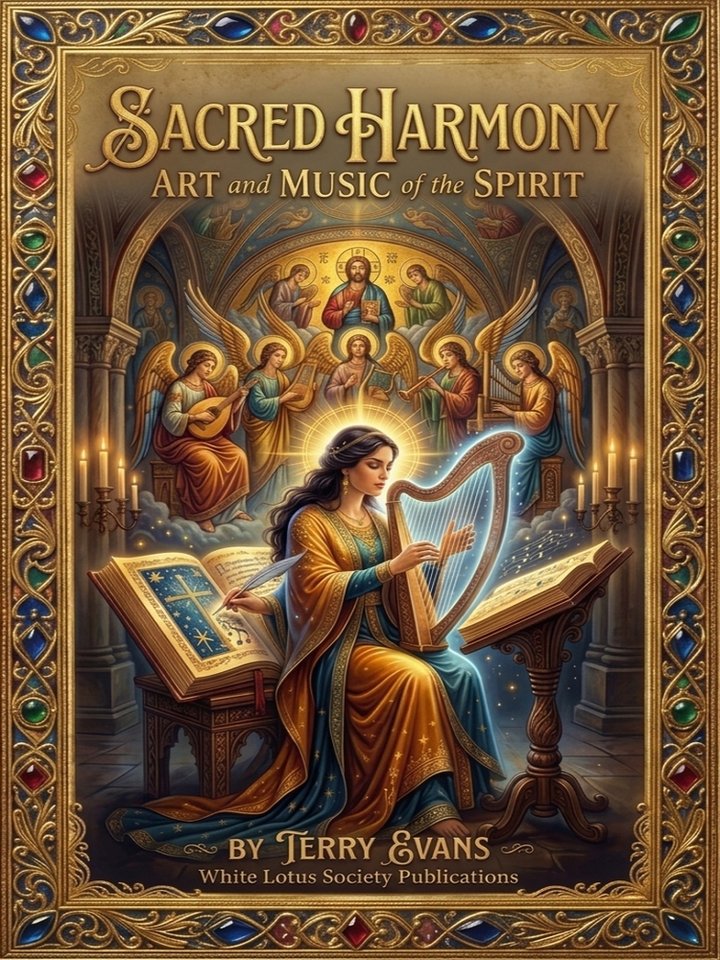
Sacred HarmonyArt and Music of the Spirit
BY TERRY EVANS · WHITE LOTUS SOCIETY PUBLICATIONS
This page, gathered into a book. Sacred image and sacred sound, from icon and cathedral to chant and choir, with the practice of making beauty as a way to the eternal. Read it on any e-reader, tablet, or phone.
Twenty essays, a resource guide, and a closing word from the street — a single long walk through sacred image, sacred sound, and the practice of making. Choose a doorway, or begin at the beginning.
The white lotus was never only a doctrine. It was a picture, a song, and a promise passed from hand to hand.
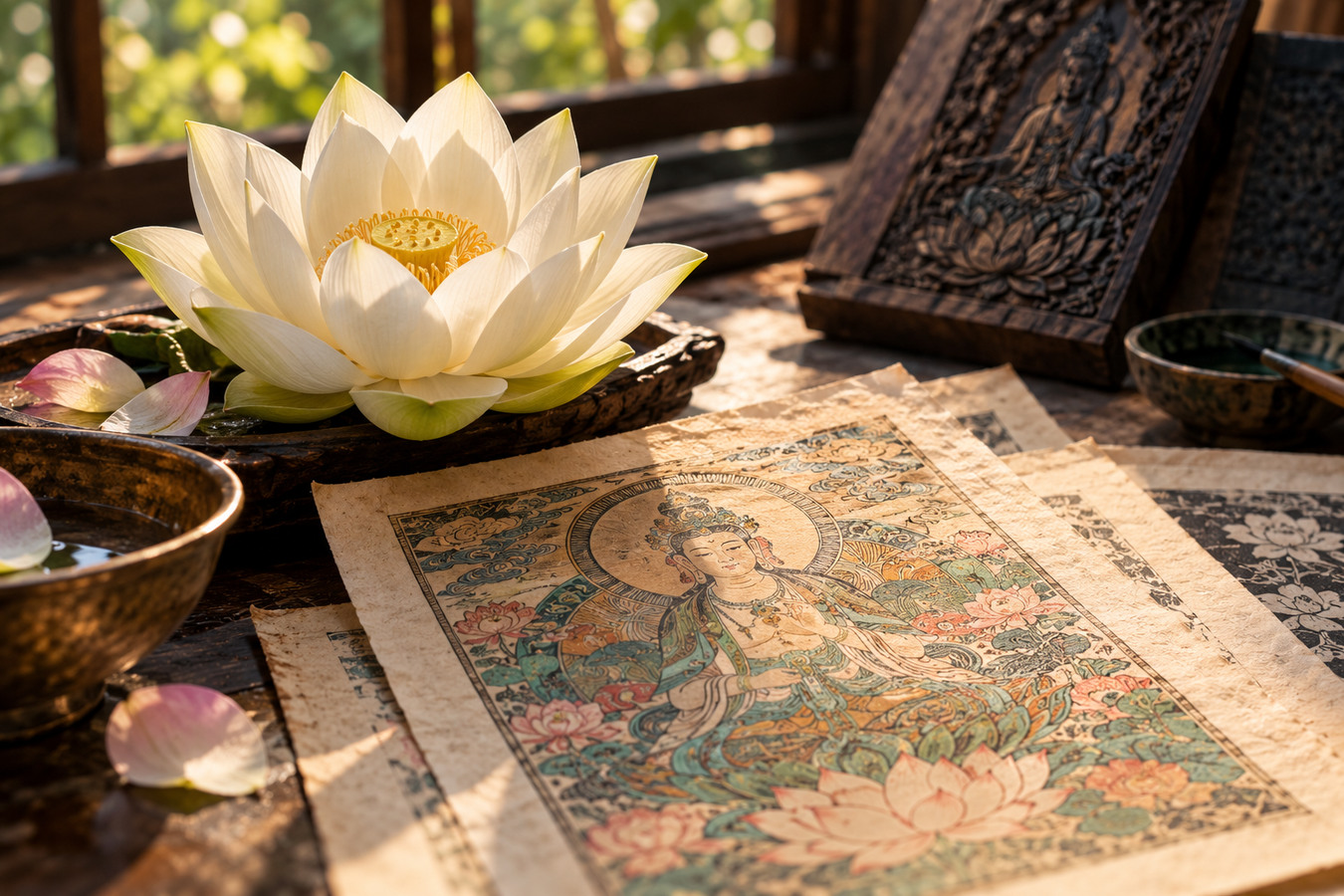
White lotus blossom beside Buddhist devotional woodblock prints
The name White Lotus holds the Pure Land fellowship Huiyuan gathered at Mount Lu in 402, the White Lotus School Mao Ziyuan organized in the twelfth century, and the family of later teachings that carried the name through the Qing. They shared no single headquarters. They shared a language of images, symbols, stories, and song. For the White Lotus, art was never ornament added after the teaching. It was how the message was translated, carried, and kept alive.
Mao Ziyuan taught lay followers of limited literacy by the Tiantai way of pictures. His diagram of the Four Lands and Three Contemplations mapped the Buddha-lands with images, verses, and tables, so that the Western Pure Land looked both beautiful and near. The picture did the work of a sermon. Handscrolls of Huiyuan's Lotus Society, in the line of Li Gonglin, gave the fellowship a luminous lineage: monks and scholars bowing, debating, and proofreading sutras beside a lotus pond.
The lotus itself carried the whole promise: purity, Nirvana, the pond at Donglin, rebirth. Painted, printed, embroidered, or simply spoken, it was a sign that could travel farther than any sermon. Prints and images gathered the faithful even in secret, and the Qing code itself named them beside incense and night meetings as the things that make a people. Sacred scriptures were set to familiar opera tunes, and illustrated precious scrolls (baojuan) were chanted, shown, and explained, so that text, image, and song became one.
A message spreads by the forms that make it feel true, beautiful, and worth sharing.
That is the road this page walks: sacred image, sacred sound, and the making of beauty as a doorway to the Eternal.
Opening
The Sacred Power of Beauty
Long before there were doctrines written down, there were hands shaping clay, voices raised in the dark, and marks pressed into stone by firelight.
Sunlit cloister arches and flowering sacred garden
Art and music did not arrive after religion as decoration for belief already settled. They arrived alongside it, and in many cases before it — as the very means by which awe first found a shape. A painted hand on a cave wall, a bone flute carved forty thousand years ago, a rhythm kept by clapping palms: these were the first translations of an experience that words alone could not carry. When a person today lights a candle before an icon, or a congregation lifts a hymn into a stone vault, they are continuing a practice as old as the human mind's capacity for wonder.
To call art and music a form of prayer is not a metaphor stretched too far. Across traditions, creative acts have functioned exactly as prayer functions: as a directed attention toward what is greater than the self, sustained long enough that something is allowed to arrive. A monk copying a manuscript letter by letter, a cantor holding a single note until the room grows still, a woodcarver following the grain rather than forcing it — each is practicing a discipline that opens onto discovery. The discipline is not opposed to the inspiration; it is what makes a stable place for inspiration to land.
Artists across history have described moments in which an image, a phrase, a melody, or a sudden clarity simply arrived — often after long labor, sometimes without warning at all. This is the epiphany at the heart of sacred creativity: the instant when effort and grace meet, and something that did not exist a moment before is suddenly, unmistakably there. This page is built around that meeting place. It moves through the world's great traditions of sacred image, object, architecture, and song, and it offers practical paths for anyone who wishes to take up the same ancient work — not as a historian looking in from outside, but as a maker looking to add one more voice to a very long chorus.
"Ars sine scientia nihil est" — art without knowledge is nothing. The medieval builders' guilds paired disciplined craft with devotional intent as a single, undivided practice.
Inspirational Art Videos
Beauty and Peace Reflect our Community and Practice
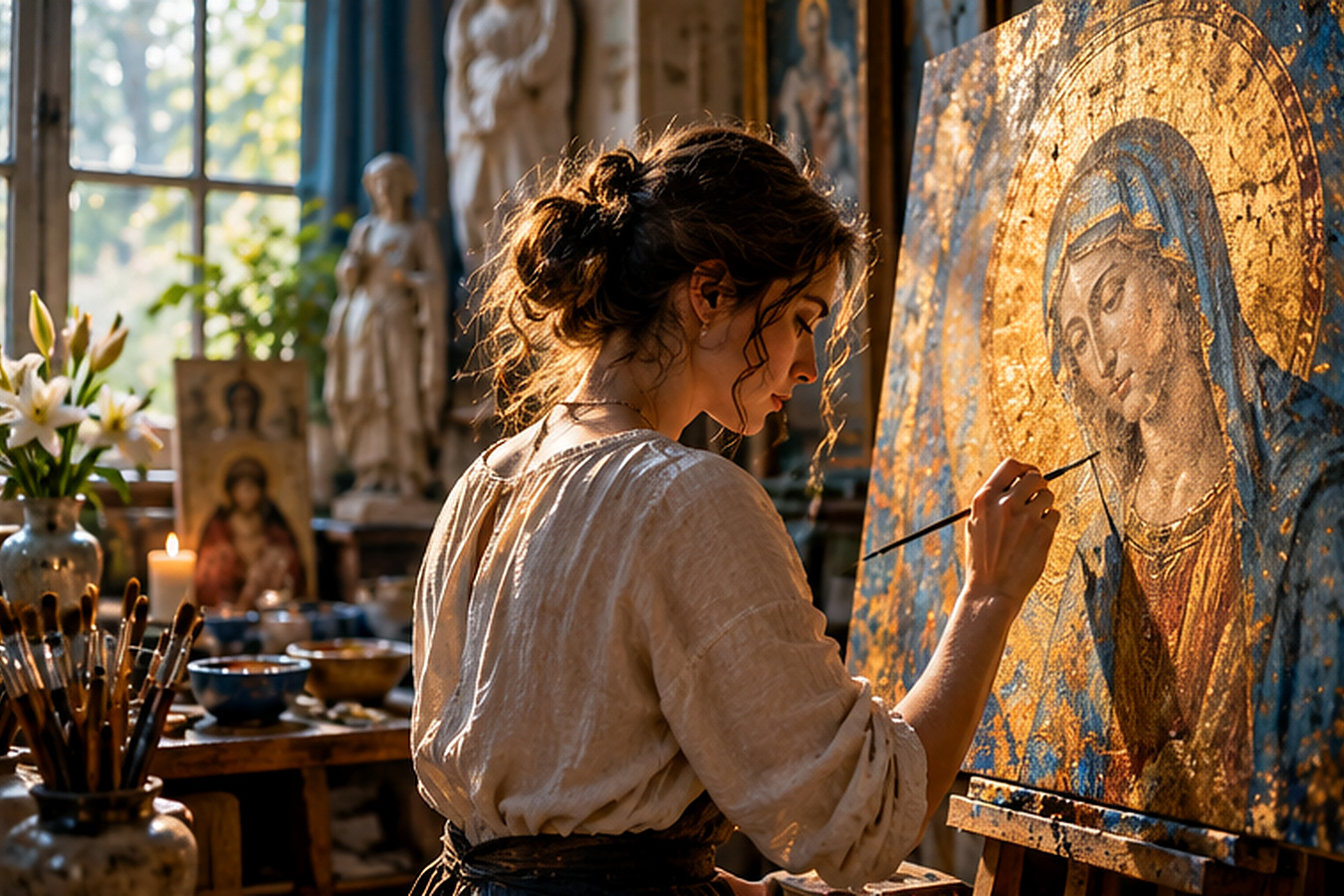
Painter creating an icon in a light-filled studio
The Alluring Beauty of Japanese Gardens
The Art of Chinese Silk | From Silkworm to Silk Road
A Train Through the Silk Road|Impressionist Oil Painting Art Film
Peace After Rain | Ancient Tao Healing & Deep Relaxation
The Untold Story of the Silk Road I Multidisciplinary Dance Production
Nuances of Chinese and Western landscape art
The Hidden Spiritual Power of Art
The Geometry in Sacred Art
One
Sacred Art Through the Ages
Every civilization that has left a trace has also left an altar, a carved figure, or a painted wall — proof that the impulse to make the sacred visible runs as deep as the impulse to survive.
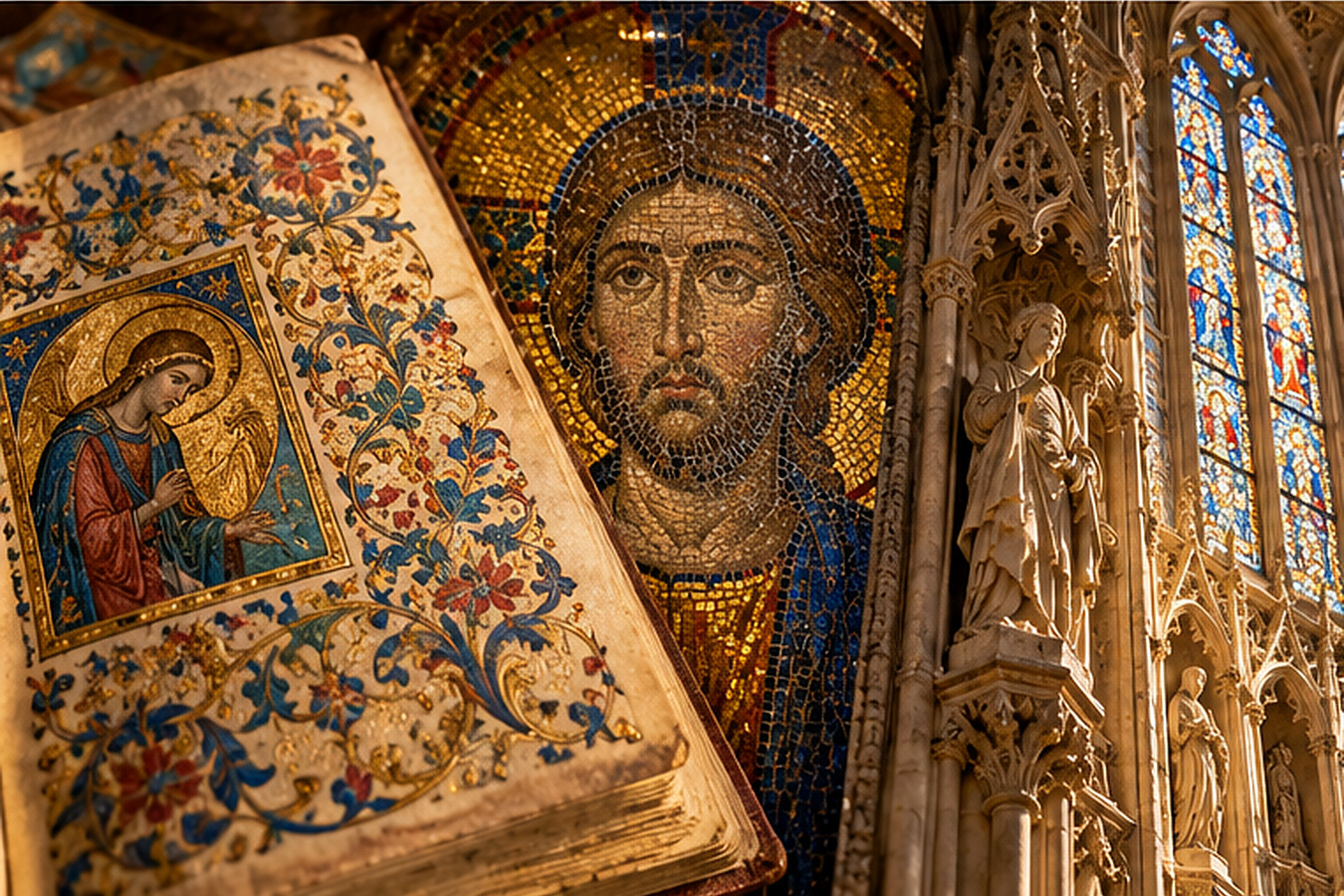
Illuminated sacred manuscript, icon mosaics, and Gothic stonework
The story of sacred art begins not in a temple but in a cave. The ochre handprints and animal processions of Lascaux and Chauvet were made by people who had no writing, yet who clearly understood that a painted image could hold power beyond its pigment — summoning, remembering, or honoring forces larger than the hunt itself. From these first marks, sacred image-making spread into every form a civilization could build: the megaliths aligned to solstice light, the ziggurats and pyramids that turned architecture itself into a ladder toward heaven, and the temple complexes of Egypt, Mesopotamia, Greece, and Rome, where gods were given faces, festivals were given processions, and cities were given a visible center of meaning.
As trade routes opened, sacred art traveled with them. The Silk Road carried not only silk and spice but Buddhist cave-temples, Nestorian crosses, Zoroastrian fire altars, and a hundred hybrid styles born where cultures met. Along these same roads, the earliest Christian art emerged quietly in the catacombs of Rome — modest images of the Good Shepherd, the fish, the anchor — coded symbols for a faith still finding its public voice. Once that voice was free to speak aloud, Christian symbolism flowered into the mosaics of Byzantium, where gold ground and solemn, frontal figures turned church interiors into windows onto eternity rather than mere pictures of it.
Medieval Europe
Illuminated Manuscripts and the Rising Cathedral
Monastic scribes turned the copying of scripture into an art of gold leaf, lapis, and disciplined patience, while masons raised the great Romanesque and then Gothic cathedrals — structures that seemed to dissolve stone into light through ever taller windows and ever thinner stone tracery.
Stained Glass and the Age of Light
Chartres, Sainte-Chapelle, and the Theology of Color
Colored glass was not simply decorative; it was understood as materialized light, a way of teaching scripture to a largely illiterate congregation while filling the nave with a radiance that medieval theologians associated directly with the divine presence.
Renaissance
The Human Form as a Vessel of the Sacred
Painters and sculptors brought anatomical precision and human warmth into devotional art, insisting that the sacred could be approached through, rather than despite, the beauty of the created human body.
Baroque and the Eastern Churches
Drama, Devotion, and the Unbroken Icon Tradition
While Western Europe embraced Baroque drama — light, movement, and emotional intensity aimed at stirring the heart — the Eastern Orthodox world preserved and deepened the older icon tradition, holding to its own theology of sacred image across the centuries.
Modern and Contemporary
New Materials, Enduring Questions
Modern religious painting, public art, photography, film, and now digital and AI-assisted media have each taken up the same original task in new materials — asking how beauty can still open a door onto mystery in a world of new tools.
What changes across this long history is style. What does not change is purpose: in every century and every medium, artists have used their materials to make the invisible momentarily visible, giving communities something to gather around, remember by, and be changed by.
Two
The Language of Symbols
A symbol says more than it shows. It carries a story, a feeling, a doctrine, and a memory all inside a single shape — often understood before it can be explained.
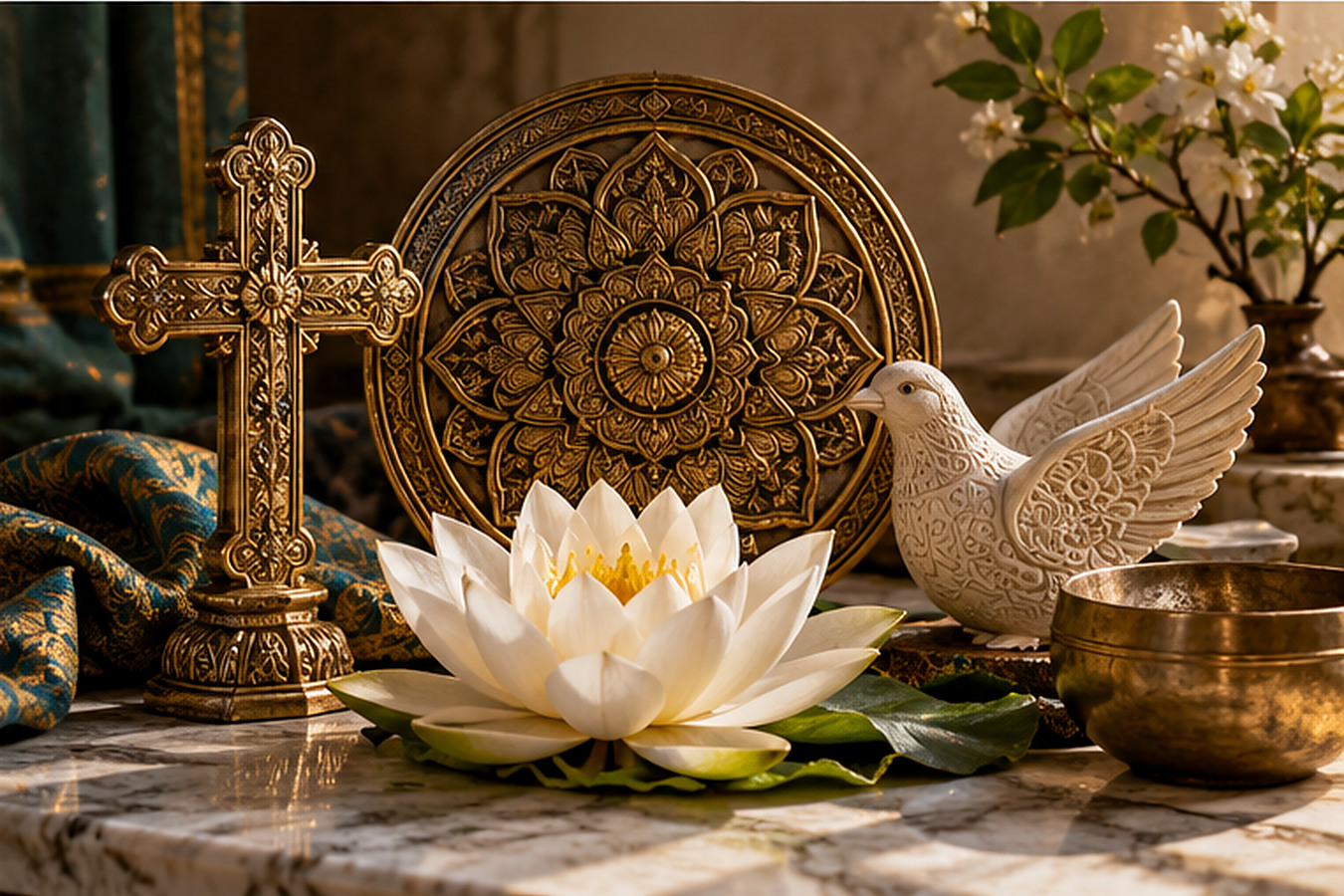
Cross, mandala, white lotus, dove, and singing bowl
Sacred symbols communicate through several channels at once: through shape and color, through their place in a story or scripture, through the gesture that accompanies them, and often through the natural forms — trees, water, fire, the sun and moon — that every culture already recognizes as bearers of meaning. A symbol works because it operates on more than one level simultaneously; a single lotus can be botanically accurate, aesthetically pleasing, doctrinally precise, and personally moving to the viewer, all without contradiction.
*
THE CROSS
The central Christian symbol, uniting suffering and triumph, sacrifice and resurrection, in a single intersecting form.
*
THE LOTUS
Rooted in mud yet flowering unstained above the water — purity and awakening rising out of ordinary, difficult conditions.
*
THE DOVE
Peace, the Holy Spirit's descent, and the safe return after the flood — gentleness as a bearer of divine presence.
*
THE CIRCLE & MANDALA
Wholeness, the turning cosmos, and the balanced interplay of complementary forces held within a single unbroken line.
*
WATER & FIRE
Cleansing, renewal, and the descent of grace on one hand; transformation, purification, and divine presence on the other.
*
THE MOUNTAIN
The meeting place of earth and heaven — Sinai, Kailash, Olympus — where ordinary ground rises toward revelation.
Even silence is a symbol — the deliberate empty space in a garden, a manuscript margin, or a held breath before the first note of a chant.
The tree of life appears from Eden to the Bodhi tree to the Norse Yggdrasil, each time expressing growth, connection between worlds, and the sustaining of life from a hidden root. Numbers, too, carry symbolic weight — three, seven, and twelve recur across traditions as markers of completeness or divine order. To learn a tradition's visual language is to gain a second vocabulary, one spoken not in words but in shape, color, and gesture, and legible the moment it is truly seen.
Three
Icons: Windows into the Sacred
An icon is not a portrait. It does not attempt to capture a fleeting likeness — it opens a window through which the viewer looks toward the one depicted.
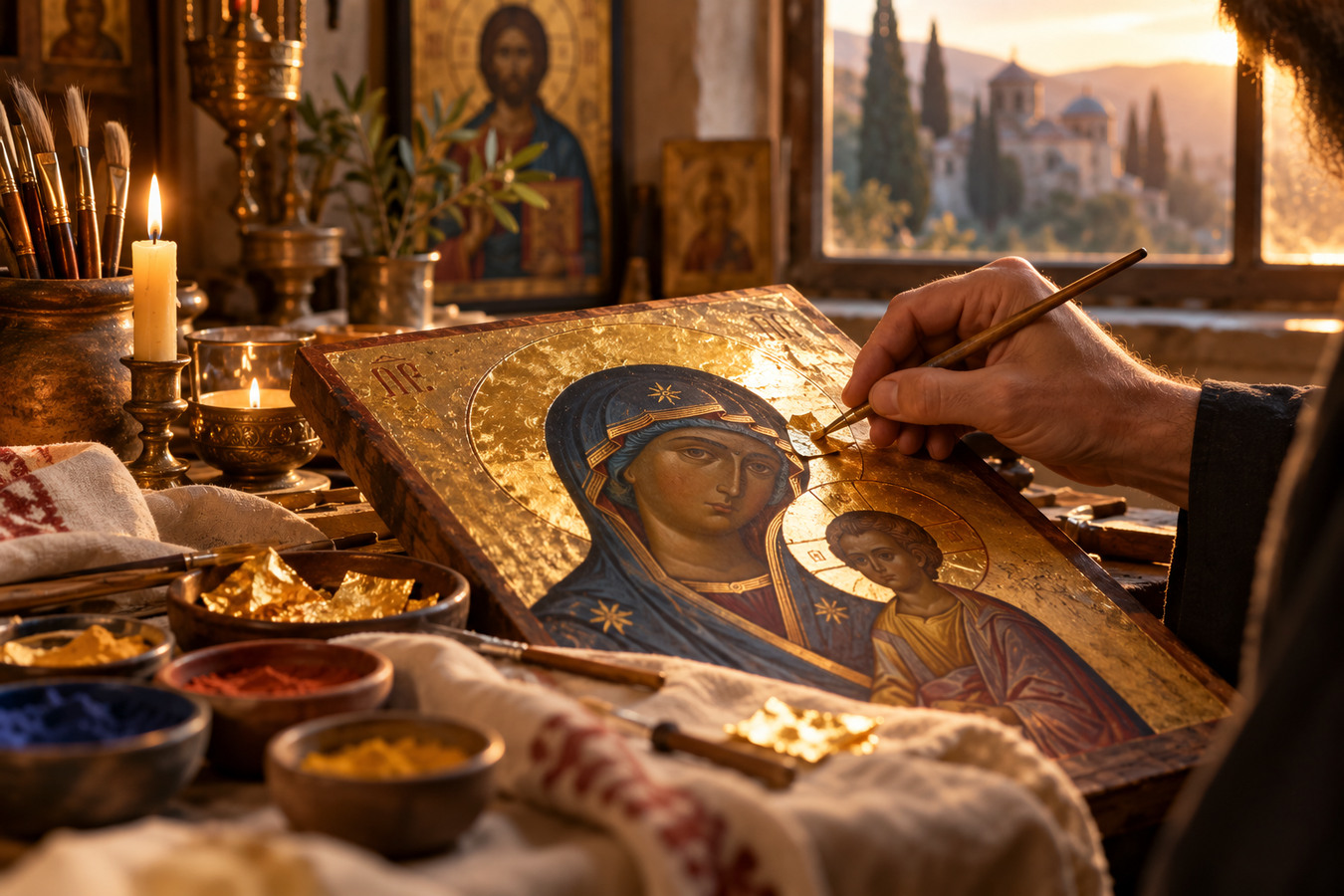
Icon artisan applying gold leaf to a devotional panel
Within Eastern Christianity, the icon occupies a place unlike any ordinary image. Its purpose is not illustration but encounter: the worshiper does not simply look at an icon, but through it, toward the sacred person it represents. This is why traditional icons avoid the single fixed light source, cast shadow, and momentary expression of Western portraiture. Figures face the viewer directly, their gaze already meeting ours; gold backgrounds dissolve any specific place or time into the timeless light of eternity.
Color itself carries theology. Deep blue and burgundy for the Virgin's robes speak of humanity clothed in divine mystery; gold signifies uncreated light rather than mere wealth; white marks purity and the resurrected state. Halos are not decorative rings but visual declarations of sanctity, showing a person already transfigured by divine presence. Even small gestures — two fingers raised in blessing, a scroll held to signify teaching — follow a settled vocabulary understood across centuries and cultures.
The iconographer's own craft is understood as a spiritual discipline rather than a purely artistic one. Traditionally, an iconographer prepares through fasting and prayer before beginning work, follows established patterns rather than personal invention, and signs no name — the work belongs to the tradition and to the one it depicts, not to the individual hand that made it. Painting an icon has long been described less as self-expression and more as an act of obedient attention, in which discipline becomes a form of prayer.
This function of the sacred image — as an aid to remembrance, contemplation, devotion, and teaching — is not unique to Christianity. Buddhist thangkas and countless other traditions likewise treat the crafted image as more than illustration: as a threshold across which the ordinary eye is trained to see what it could not see unaided.
Four
Sacred Artifacts and Religious Objects
A chalice of hammered silver. A string of worn wooden beads. A bell cast to sound one particular note for a thousand years. Ordinary materials, transformed by purpose and by patient hands.
Historic devotional books, candle and altar objects
Walk through any collection of religious artifacts and you find the same story told in different materials: wood, stone, metal, glass, cloth, ink, and clay, each shaped by craftsmanship into something that now carries far more than its material worth. A chalice is only silver until it becomes the vessel that holds what a community understands as sacred. A rosary is only beads and cord until ten thousand repeated prayers have worn a particular smoothness into its surface.
*
ALTARS & VESSELS
The chalice, paten, incense burner, and altar itself — the physical furniture around which the central rites of a tradition are enacted.
*
PRAYER BEADS & MALA
Rosaries, mala beads, and prayer ropes give the hand a task while the mind and heart are given to repeated, counted devotion.
*
BELLS & SOUNDING OBJECTS
Bells, singing bowls, and gongs mark sacred time, call a community together, and are themselves treated as instruments of purification.
*
SCRIPTURES & MANUSCRIPTS
Illuminated Gospels and sutra scrolls preserve not only text but the craft tradition of the scribes who copied them by hand.
*
RELIQUARIES & STATUARY
Vessels built to house what a community holds most precious — the remains, image, or memory of a revered figure.
*
CEREMONIAL DRESS & TEXTILE
Vestments, prayer shawls, and ceremonial robes mark the wearer's role within a rite and preserve textile traditions across generations.
Religious objects are, among other things, an archive: they preserve the memory of the hands that made them, the rituals in which they were used, and the communities that gathered around them. To hold an object crafted for worship centuries ago is to hold both the material itself and the accumulated attention of everyone who ever used it for its intended purpose.
Five
The Beauty of Church Architecture
A sacred building is an argument made in stone, wood, and light about what a human being is and what a human being is for.
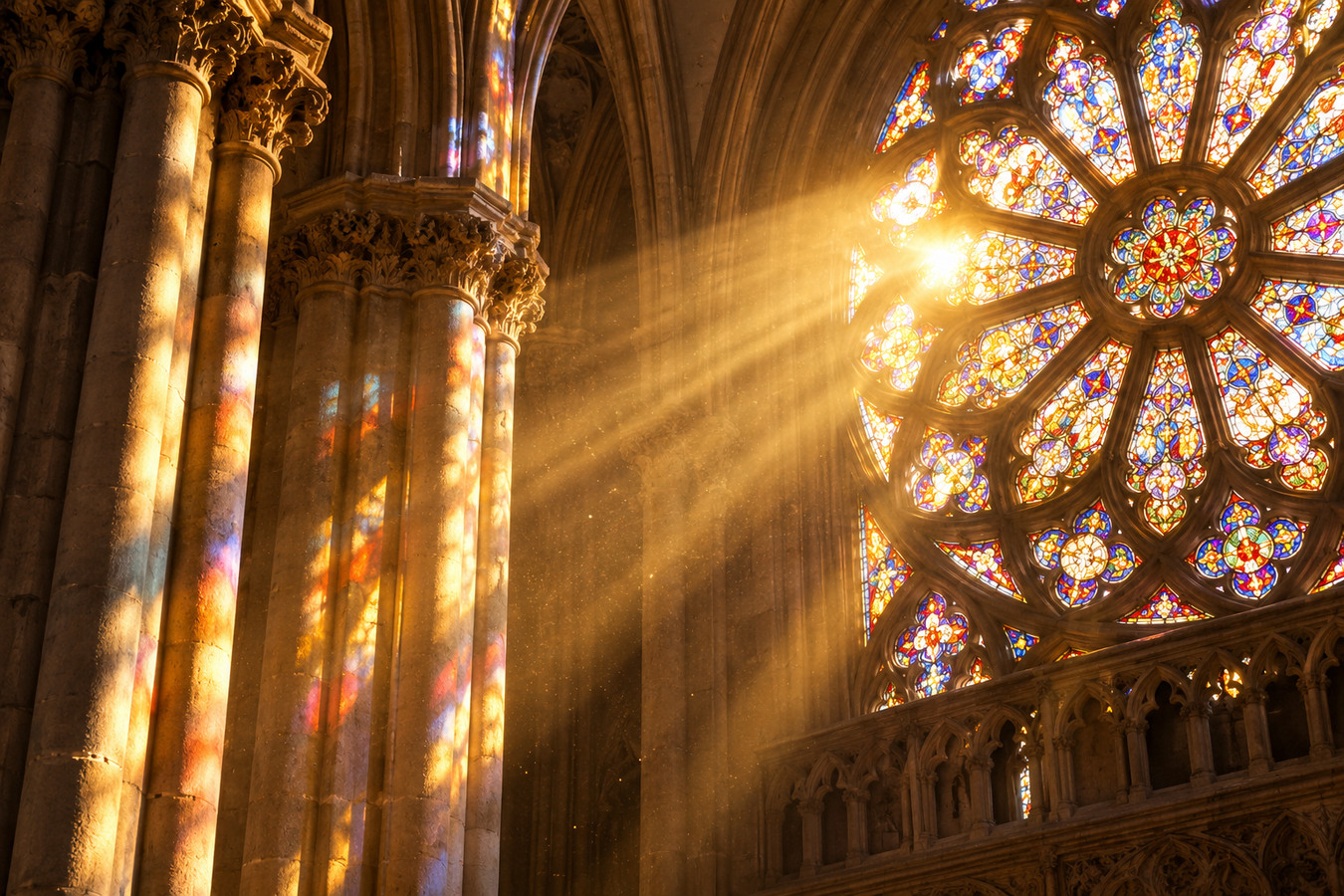
Radiant stained-glass rose window in a vaulted Gothic cathedral
The Gothic Cathedral
The Gothic builders discovered that with pointed arches, ribbed vaults, and flying buttresses, weight could be carried outward and downward through a slender skeleton rather than through massive walls — freeing the walls themselves to dissolve into glass. The result was architecture that seemed to defy its own material, drawing the eye and, with it, the spirit, continually upward.
Domes and Bell Towers
Where the Gothic vault reaches upward in a line, the dome gathers space into a single unified sky overhead — a favored form from Byzantium through the Renaissance, each reading the dome as an image of the heavens themselves. Bell towers, meanwhile, extend a community's rhythm of prayer out into the wider town, calling the faithful across distances no voice alone could reach.
Sacred Geometry and Monastic Plan
From the cruciform floor plan of the Western church to the mandala-based layout of a Buddhist temple complex, sacred architecture has long encoded theology directly into proportion and orientation. Monastic architecture in particular arranges cloister, chapter house, refectory, and church around a quiet central garden, embodying in stone a rhythm of communal life ordered entirely around prayer.
The Modern Chapel and the Garden
Contemporary sacred architecture has often turned toward simplicity — plain walls, a single shaft of directed light, unadorned wood — trusting restraint itself to create room for contemplation. Outdoor worship spaces and sacred gardens extend this same instinct, treating a well-placed bench beneath a tree as no less a sanctuary than a vaulted nave.
Architecture does not merely house worship — it teaches the body, before the mind catches up, where to look, when to fall silent, and how to feel small in a way that is not diminishment but rest.
Six
Religious Music Through the Ages
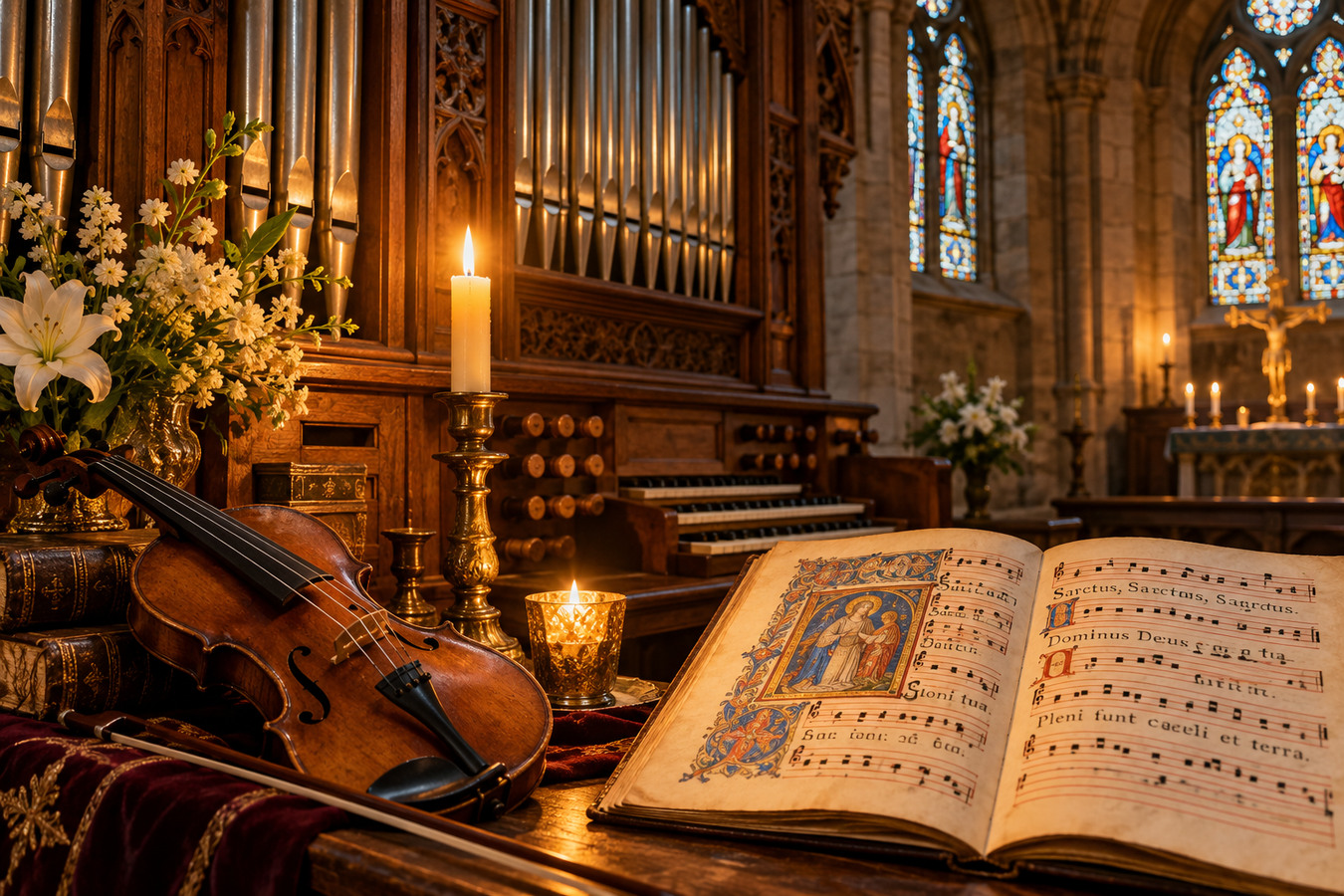
Violin, illuminated chant manuscript, organ and candlelit church
FEATURED EPUB
The Voice That RisesSinging as Breath, Meditation, and Prayer
BY TERRY EVANS · WHITE LOTUS SOCIETY PUBLICATIONS
From the caves to the cathedrals, from the caravans of the Silk Road to the gospel choir, the human voice has lifted the heart toward the Holy. Discover what singing does for the lungs, the heart, the memory, and the spirit, and how every song is breathwork, meditation, and prayer in one. With simple practices for your home church and your own quiet room.
Another High Level Arts; Beautiful choreography, Beautiful music, Beautiful dancers
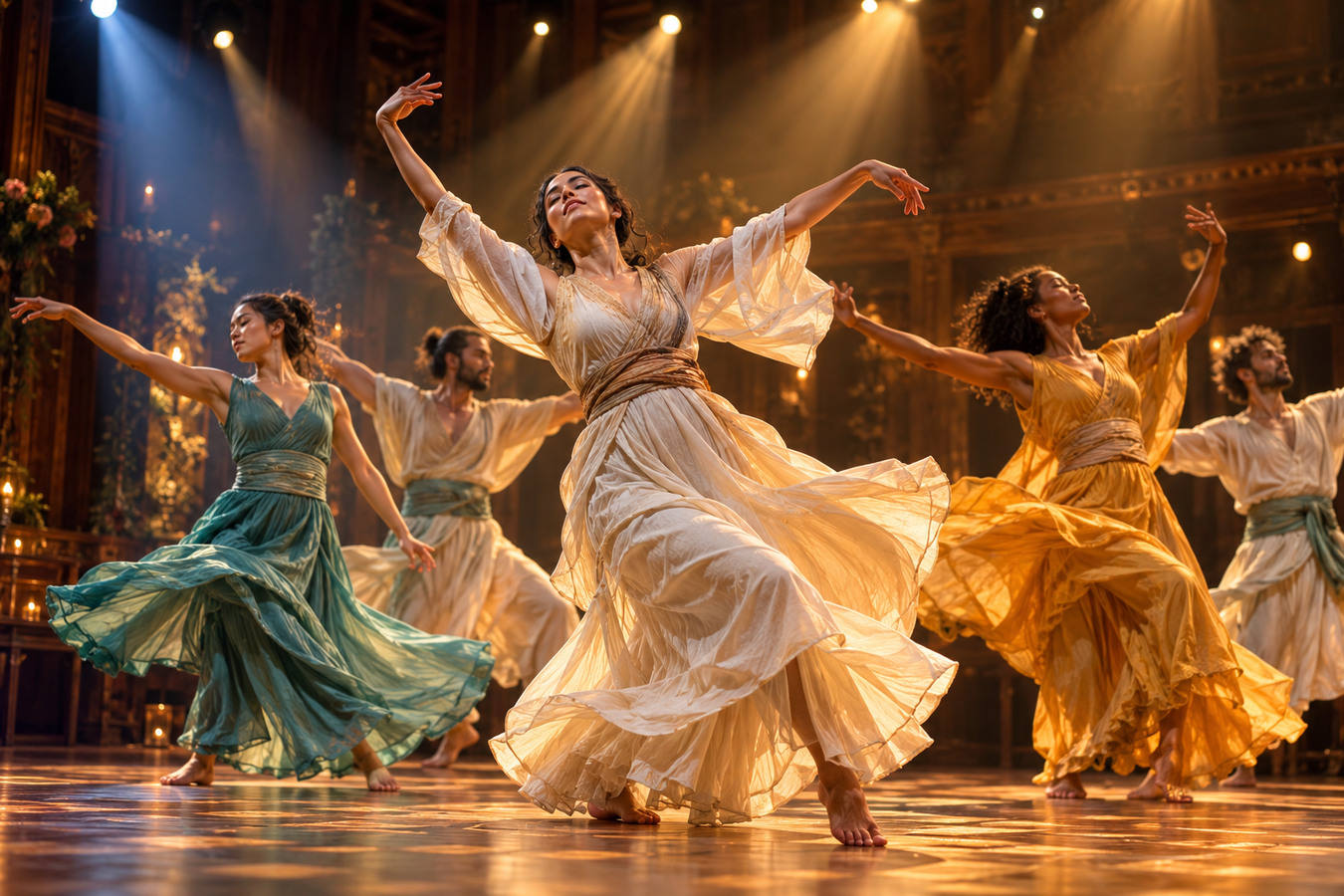
Expressive dance performance illuminated by golden stage lights
Thousand Hand Bodhisattva
Thousand-Hand Bodhisattva
Jasmine Dance
Silk Road Dance
Dingbu Bridge
Heavenly Shower
Crested Ibis; Oriental Swan Lake
Auspiciousness/Good Luck
Spiritual Music
Every generation of believers has needed new music, because every generation has carried its faith, its grief, its joy, and its hope in a voice that was recognizably its own.
Violin and music manuscript in a candlelit sanctuary
Ancient World
Chant Before Notation
Long before music was written down, sacred chanting shaped worship across the ancient Mediterranean world and early Buddhist India — melody carried entirely by memory, teacher to student, generation to generation.
Early Church
Christian Chant and Gregorian Reform
Early Christian worship absorbed older psalmody and Greco-Roman melody alike, eventually organized into the unified, unaccompanied plainchant that came to be called Gregorian chant — modal, unmetered, and built to let text and breath, rather than a fixed beat, shape the line.
Eastern Christendom
Byzantine and Eastern Chant
The Eastern churches developed their own distinct chant systems — built on the Byzantine oktoechos and, in other traditions, on further regional modal systems — preserving a cappella singing as the primary vehicle of the liturgy to this day.
Medieval Monasteries
Monastic Singing and Early Polyphony
Monastic communities structured entire days around the sung hours of the Divine Office, and it was within these same communities that composers first began layering independent melodic lines into polyphony, adding harmonic depth to the chant tradition.
Reformation
Hymns and the Congregation's Voice
The Reformation placed new emphasis on the gathered congregation singing together in its own language, giving rise to the hymn tradition and to the belief that every worshiper, not only the trained choir, had a voice worth raising.
The Americas
Spirituals and Gospel
Out of profound suffering and unshaken faith, African American communities created the spiritual and, later, gospel music — traditions built on call and response, testimony, and a joy that refuses to be silenced by circumstance.
Modern and Contemporary
Organ, Choir, and New Instruments
Classical sacred composers gave the church cantata, requiem, and oratorio; the pipe organ became the great instrument of Western liturgical music; and in recent decades, contemporary worship music, Christian rock, ambient and electronic meditation music, and independent artists across traditions have continued to find new sonic languages for the same old devotion.
What unites plainchant and gospel is not style but function: each was built by a community to carry what could not be simply spoken — grief, repentance, longing, celebration, and the plain fact of gratitude for being alive.
Seven
The Power of Chant and Repetition
A single word said once is information. The same word said a hundred times, on the breath, becomes something closer to a place the mind can live in.
Monastic singers in a candlelit choral procession
Repetition works on the human mind and body in ways that plain speech does not. A repeated phrase steadies attention, quiets the restless surface of thought, and — sung or chanted together — knits separate people into a single rhythm of breath. This is why so many unrelated traditions independently discovered the same tool.
CHRISTIAN CHANTING
The Jesus Prayer, sung psalmody, and monastic plainchant use short repeated phrases to still the mind and turn attention toward continual prayer.
BUDDHIST CHANTING
Sutra recitation and mantra repetition, often paced to the breath and sometimes to a mala's beads, cultivate concentration and compassion.
TAOIST CHANTING
Ritual invocation and scripture recitation, often accompanied by bell and drum, regulate the breath and align the practitioner with the rhythms of the Tao.
Wherever human beings have prayed together, they have discovered that breath, rhythm, and repeated sound help memory hold what a single hearing cannot, and help a room full of separate people become, for a few minutes, one.
Eight
Building a Modern Sacred Music Program
A healthy music ministry does not choose between tradition and innovation. It holds both, and lets each generation find its own place inside the whole.
Violin and score prepared for a sacred music program
Honor the Root
Maintain the traditional choir as the anchor of the program
Preserve seasonal music tied to the liturgical or festival calendar
Keep a well-organized digital and physical music archive
Invite elders to teach the community's older repertoire directly
Welcome New Growth
Add a contemporary worship band alongside the traditional choir
Host acoustic ensembles and instrumental meditation sets
Run songwriting groups for members who wish to compose their own music
Offer occasional online performances and a simple digital archive
Bringing the Community Together
The strongest programs create regular points where every part of the music ministry meets the whole congregation at once: an annual seasonal concert that features every ensemble, an open workshop where beginners of any age can learn an instrument, a guest-musician evening that introduces new sounds without displacing familiar ones, and a community festival built around shared singing rather than passive listening. None of this requires large budgets. It requires only a willingness to treat music as something the whole community makes together, rather than something professionals provide for everyone else to watch.
Nine
Music and Community
A congregation singing together is not an audience watching a performance. It is a community, for a few minutes, becoming a single instrument.
Choir singing in warm light beneath a stone church vault
Collective singing binds people together in ways few other shared activities can. When a room full of separate voices — some trained, most not — align around a single melody, the ordinary boundaries between performer and listener dissolve. Everyone present is doing the same thing at the same time, breathing at the same pauses, holding the same note. This shared physical act builds a kind of belonging that mere presence in the same room does not.
Singing together also preserves memory across generations in a way that few other practices can match. A grandparent and grandchild who know the same hymn by heart share something that requires no explanation to pass between them; a melody learned in childhood can return, word for word, decades later at a funeral, a wedding, or a holiday gathering, carrying the whole of a life's worth of context with it. Processions, festivals, and the ordinary rhythm of weekly worship all depend on this same quiet power — that a shared song does more to knit a community together than a shared idea alone ever could.
At a wedding, a funeral, or a holiday feast, it is often the moment of collective singing — not the sermon, not the meal — that people remember most clearly years later.
Ten
How to Start a Church Choir
A choir does not need to begin large, trained, or polished. It needs only a few people willing to show up and sing together on purpose — and it is, in its own small way, the most direct application of everything this page has explored.
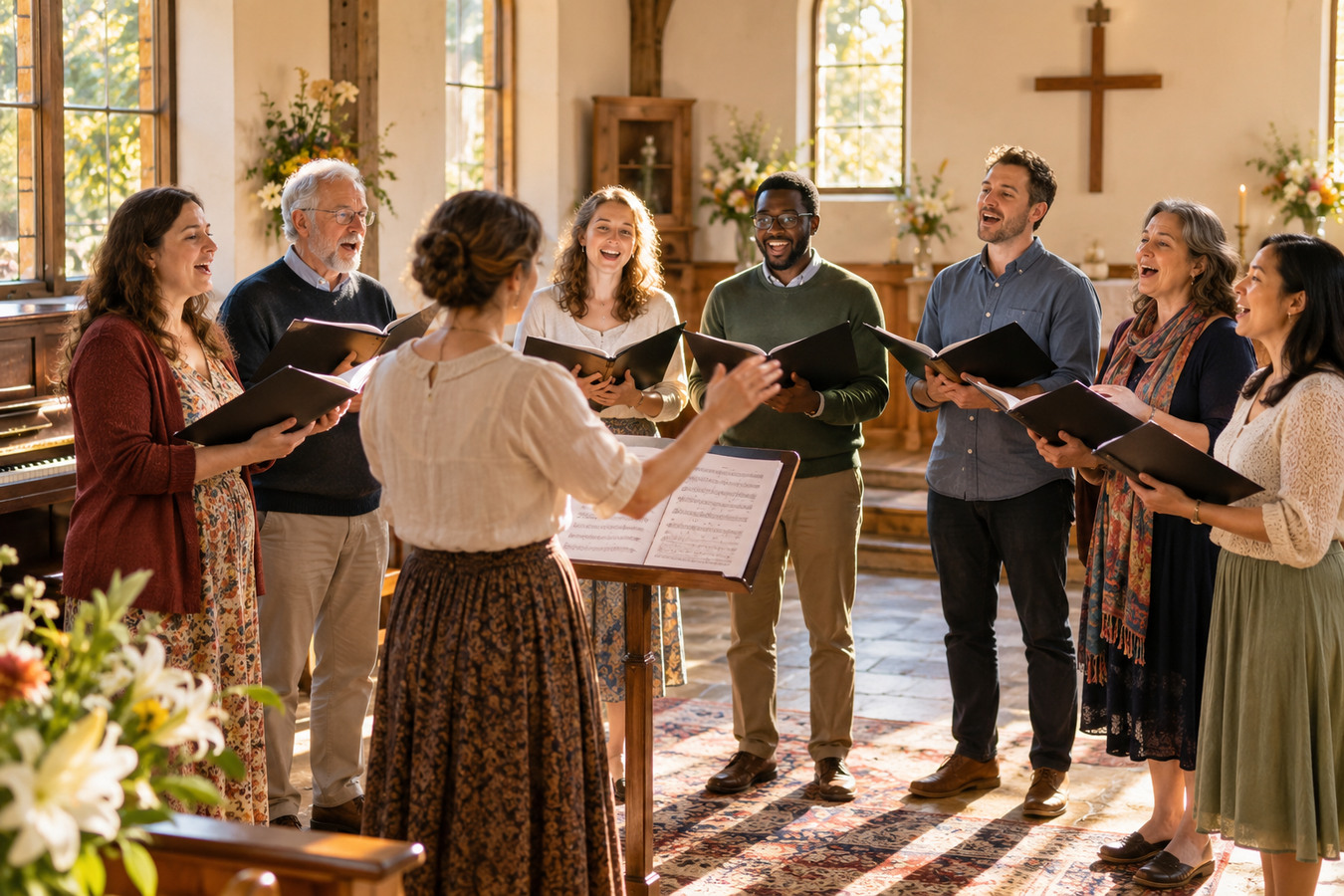
Community choir rehearsing together in a sunlit chapel
The purpose of a church choir is not performance for its own sake but service — leading a congregation's song, deepening the beauty of worship, and giving a group of people a shared creative practice rooted in something larger than themselves. Every great choral tradition, from a monastery's schola to a small rural congregation's Sunday quartet, began at this same modest starting point: a handful of willing voices and someone patient enough to gather them. What follows is a fuller, practical walk through that beginning — from the first invitation to the choir's long-term life within a community.
Why a Choir Matters Before You Build One
It helps to be clear about purpose before recruiting a single singer. A choir exists first to serve the congregation's worship, not to showcase individual talent; its music should draw attention toward the sacred, not toward itself. It exists second to give its own members a sustained creative and spiritual practice — regular rehearsal is, for many choir members, one of the few consistent contemplative disciplines in an otherwise scattered week. And it exists third to build community: shared rehearsal time, shared performance, and shared imperfection create bonds that few other church activities produce as reliably. Holding all three purposes in mind from the outset — worship, practice, and belonging — keeps a young choir from drifting toward either empty performance or directionless socializing.
Laying the Foundation
Start with whoever shows up. Open participation, rather than formal auditions, is almost always the right choice for a new choir — the goal at this stage is building a group, not gatekeeping one. A choir of willing amateurs that grows in skill over time will outlast a choir of skilled strangers who never bonded.
Find a willing director. This does not require a professional musician; it requires someone patient, organized, musically comfortable enough to teach a part by ear, and willing to lead simple rehearsals while keeping the group's spirit warm. A gifted amateur with real commitment will serve a new choir better than an occasional professional who cannot show up consistently.
Set a simple, repeatable rehearsal rhythm. A short weekly rehearsal, at a consistent time and place, builds far more momentum than occasional long sessions. Consistency, more than length, is what turns a group of individuals into an ensemble.
Choose music the group can actually sing. Begin with unison or simple two-part pieces well within everyone's range, and let confidence — not ambition — set the pace of growth. A simple piece sung with full conviction moves a congregation more than a difficult piece sung tentatively.
Welcome every age and ability. Children's choirs, adult ensembles, and mixed intergenerational groups each bring something different; none needs to wait for the others to be "ready." A congregation that hears both a child's unpolished solo and a seasoned alto in the same season is hearing the full range of what a community's voice can be.
Add instruments as they appear. A single piano, guitar, or accompanist is enough to begin; larger instrumentation — strings, winds, a small rhythm section — can grow naturally as members and volunteers offer their own skills.
Build a small music library. A simple binder or shared digital folder of well-chosen pieces, organized by season and occasion, saves enormous time as the choir grows and makes it possible to hand leadership to a new director without starting from nothing.
Let performance follow readiness. Sing during regular worship as soon as the group is ready for even one simple piece, then build toward holidays and special ceremonies as skill and confidence grow together.
Protect the joy of it. Keep rehearsals warm, unhurried, and social — shared food, shared laughter, and genuine friendship are not distractions from a choir's purpose; they are part of it. A choir that people look forward to attending will always outperform one that people merely attend out of duty.
Finding and Welcoming Singers
Extend a personal invitation rather than only a printed announcement — most people join a choir because someone specifically asked them, not because they saw a flyer
Make clear that reading music is not required; teaching parts by ear is a long and honorable tradition
Offer a genuinely low-pressure first visit — "come try one rehearsal" invites far more people than "please commit for the season"
Pair a new singer with an experienced one nearby in rehearsal and in the loft, so no one has to find their part alone
Actively recruit across generations — ask parents about their children, and ask elders about their own choir memories
Reassure hesitant singers that a choir needs steady, willing voices far more than it needs solo talent
Choosing a Director and Sharing Leadership
Look first for patience and reliability, then for musical skill — both matter, but the first is harder to substitute for
A director does not need a formal music degree; many fine church choirs are led by devoted, self-taught musicians
Rotate small responsibilities — warm-ups, section leading, music folders — among a few members so the choir does not depend entirely on one person
Give the director real say over repertoire, but keep the whole choir informed of the season's plan well in advance
Plan early for succession; a choir with only one person who knows how anything works is a fragile choir
Structuring Rehearsals That Work
A good weekly rehearsal has a shape people can rely on: a short shared warm-up to bring voices and attention into the room together, a review of familiar material to build confidence before anything difficult, focused work on one or two new sections rather than an entire piece at once, and a closing runthrough that ends the rehearsal on something the choir can already sing well. Ending on strength, rather than on the hardest unfinished passage, sends every singer home encouraged rather than discouraged — a small detail that shapes whether people return the following week.
Working with Children's Choirs
Children's choirs thrive on shorter rehearsals, simple repeated songs, movement alongside singing, and a great deal of encouragement for effort rather than only for accuracy. A children's choir does not need to sing difficult music to be genuinely moving to a congregation — a simple, sincerely sung piece from a group of young voices often becomes a community's most treasured moment of the year.
Working with Adult and Mixed Ensembles
Adult choirs benefit from clear part assignments, patient section-by-section teaching, and realistic expectations about members' available time. Mixed intergenerational choirs additionally need music simple enough for the youngest members and dignified enough to hold the interest of the oldest — a balance best found by choosing pieces of genuine emotional depth rather than merely simple ones.
Instruments, Accompanists, and Small Ensembles
Most choirs begin with a single accompanist — piano, organ, or guitar — and that is entirely sufficient for a very long time. As a choir grows, instrumentation can expand naturally: a volunteer flutist joining for a single Easter anthem, a small string trio for a Christmas service, a guitarist leading simpler contemporary pieces at an evening service. There is no requirement to expand instrumentation on any fixed schedule; the right time to add an instrument is when a willing and able musician appears, not before.
Building a Music Library
A church choir's music library does not need to be extensive to be useful — it needs to be organized. A simple system sorted by season (Advent, Lent, Easter, Ordinary Time, or the equivalent structure of the community's own calendar) and by occasion (weddings, funerals, festivals) allows a director, new or experienced, to plan a season quickly rather than starting from nothing each time. Keeping both physical folders and a digital backup protects years of accumulated choices from being lost to a single misplaced binder.
From Sunday Worship to Holidays and Special Ceremonies
A new choir's first appearance in worship should be modest and well within its ability — one simple piece, sung with confidence, does more for a congregation and for the choir's own morale than an ambitious piece sung shakily. From that first successful appearance, a choir naturally grows toward the larger occasions of the year: the particular music of Christmas or a major festival, the solemnity appropriate to Holy Week or a period of communal mourning, the joy appropriate to a wedding or a homecoming celebration. Each season adds a small amount of repertoire that becomes, over years, the choir's own settled tradition.
Christmas Caroling and Seasonal Outreach
Caroling is one of the oldest and most joyful ways a choir extends its music beyond the walls of the church, carrying song out into homes, streets, and care facilities during the darkest and brightest weeks of the year. It requires almost none of a choir's usual infrastructure — no accompanist, no sheet music stands, no amplification — only voices, a short memorized repertoire, and the willingness to go out into the cold.
Choose a short, memorized repertoire. Five to eight familiar carols, sung from memory rather than from paper, keep the group mobile, keep hands free for candles or songbooks for guests, and let singers make eye contact with the people they are singing to.
Plan the route in advance. Neighborhood streets, a retirement community, a hospital ward, the homes of homebound members — choose a route that fits the time available and confirm any facility visits ahead of time with staff.
Dress for the weather, not for the loft. Warm coats, comfortable shoes, and layers matter more on a caroling night than any uniform; a few battery-powered candles or small flashlights help everyone read the same simple song sheet in the dark.
Invite the whole congregation, not only the choir. Caroling is one of the easiest entry points for people who would never audition for a choir but would happily come along to sing three familiar songs on a porch.
Prioritize those who cannot come to church. Homebound members, nursing home residents, and hospital patients often remember a caroling visit long after the season has passed; build the route around them before adding purely festive stops.
End somewhere warm. Hot cider, cocoa, and a shared meal after an evening of caroling turn a service activity into a cherished annual tradition members look forward to year after year.
Take a few photos, but stay present. A handful of pictures preserve the memory; treat the visit itself, not the documentation of it, as the point.
ADVENT LESSONS & CAROLS
A service alternating scripture readings with seasonal choir anthems and congregational carols, building anticipation across the four weeks before Christmas.
CHRISTMAS EVE CANDLELIGHT
A candlelit service closing on a hushed, unaccompanied carol is one of the most remembered moments a choir will ever sing.
WATCHNIGHT SERVICE
An evening or midnight service crossing into a new year, rich with musical tradition in many congregations, especially in the Black church.
EPIPHANY & TWELFTH NIGHT
Music marking the visit of the Magi closes the Christmas season with its own smaller, quieter musical character.
PALM SUNDAY PROCESSION
A processional hymn sung while walking, sometimes with palm branches, launches Holy Week's most dramatic week of music.
GOOD FRIDAY & TENEBRAE
Music grows sparse and solemn, often stripped to a single voice or instrument as the church's lights are gradually extinguished.
EASTER SUNRISE SERVICE
An outdoor or unaccompanied dawn service, often the choir's most triumphant music of the year, sung as the light returns.
HARVEST & THANKSGIVING HYMN SING
An open, informal hymn sing inviting requests from the whole congregation builds gratitude and communal ownership of the choir's repertoire.
BLESSING OF THE ANIMALS
A lighter seasonal service, often in early October, pairing simple music with a joyful, informal congregation-wide gathering.
Creating a Drum Circle
A drum circle is one of the most ancient and most accessible forms of sacred music-making, requiring no written notation, no auditions, and no prior musical training — only a willingness to keep a beat and to listen to the people beating alongside you. Where a choir gathers around melody and text, a drum circle gathers around rhythm and breath, and it welcomes an entirely different set of people into a community's musical life: those who have never sung a note but who can keep time with their hands.
Start with whatever drums exist. A handful of hand drums, a djembe or two, a frame drum, even overturned buckets and a tambourine are enough to begin; a drum circle does not require matched or expensive instruments to be genuinely good.
Choose a facilitator, not a director. A drum circle is led rather than conducted — someone who can establish a steady base rhythm, cue transitions with a simple signal, and draw quieter members in without ever needing to "correct" a beat in front of the group.
Sit in an actual circle. The circular arrangement is not incidental; it lets every player see and hear every other player, and it visibly embodies the equality of everyone present, regardless of experience.
Begin with a simple, shared pulse. A slow, steady heartbeat rhythm that everyone can hold gives newcomers an immediate way to participate, before any layered or more complex rhythms are introduced.
Layer parts gradually. Once the base pulse is steady, invite one or two players to add a second, complementary rhythm; resist adding complexity faster than the circle can hold it together.
Welcome complete beginners without hesitation. A drum circle that insists on skill loses its central gift — anyone with two hands and a willingness to listen can contribute meaningfully within minutes.
Let silence and dynamics do real work. A facilitator's raised hand for a sudden hush, or a slow build from a whisper to a full circle at volume, teaches a group as much about listening together as any words could.
Close deliberately. A drum circle that simply trails off feels unfinished; a clear closing signal — a final unified strike, a slow fade to silence — gives the shared experience a felt ending.
Many traditions already understand drumming as sacred practice in its own right: the taiko traditions of Japanese Buddhist and Shinto festivals, and the wider human practice of rhythm as shared prayer stretching back across recorded history. A congregation building its own drum circle is not inventing something new so much as joining a very old, very wide tradition — simple, communal, and rooted in nothing more than the willingness to keep time together.
Music in the Park
Taking music outdoors, into a public park or green space, does for a congregation's music what caroling does for its carols: it carries something usually contained within four walls out into the wider life of a community, and it invites people who might never walk into a sanctuary to encounter it anyway. An outdoor gathering built around music — simple, low-pressure, and open to the whole neighborhood — is one of the most effective and joyful forms of community outreach available to any music program.
Planning an Outdoor Gathering
Choose a public park with easy parking, shade, and simple restroom access rather than the most scenic possible spot
Keep the format loose — a blanket-and-lawn-chair gathering invites participation far more readily than rows of formal seating
Bring only what travels easily: hand drums, a guitar or ukulele, a portable keyboard, printed lyric sheets in large type
Schedule around the light and the season — a late-afternoon start that runs into golden hour, or a cool morning gathering in high summer
Advertise it as open to the whole neighborhood, not only the congregation, and mean it
What to Offer Once You're There
An informal hymn sing or folk-song sing-along that welcomes requests from anyone present
A drum circle running alongside, so both singers and non-singers have a way in
A children's corner with simple percussion — shakers, small hand drums, tambourines — so the youngest visitors can join immediately
A quiet listening set later in the gathering, once energy has settled, for those who came simply to sit and receive rather than to participate actively
Food and conversation afterward, so the music becomes the doorway into relationship rather than the whole of the event
Neither a drum circle nor a park gathering requires a single trained musician to succeed. Both ask only for a few willing people, a handful of simple instruments, and an open invitation — the same modest beginning every tradition in this section has grown from.
Singing at Weddings and Funerals
Weddings and funerals ask something different of a choir than a regular Sunday service: music chosen for one specific family, at one of the most significant moments of their lives, rather than for the congregation in general. A small, flexible group of choir volunteers — sometimes as few as two or three singers — willing to learn a family's particular requested piece is an invaluable resource. Keep a short list of singers comfortable with solo or small-ensemble work, maintain a simple, respectful process for meeting with the family beforehand to understand their wishes, and be prepared to sing music outside the choir's usual repertoire with the same care given to a regular service.
Choir Robes and Visual Presentation
Robes are not required for a choir to be beautiful, but a shared visual presentation — whether formal robes, simple stoles over everyday clothing, or a agreed color of shirt — helps a congregation recognize the choir as a unified body offering something on their behalf, rather than a loose cluster of individuals. New choirs can begin with no uniform at all, add simple matching stoles as a first step, and move toward robes only once the group and its budget are ready; secondhand robes, often available inexpensively from choirs that have retired or resized their own set, are a common and practical way to begin.
Funding a Growing Choir
Start with what already exists — a piano the church already owns, photocopied or public-domain sheet music, borrowed folders
Ask the congregation directly for specific needs rather than a vague general fund — "new folders for twelve singers" raises money faster than "choir expenses"
Apply small designated gifts or memorial funds toward music, robes, or instrument repair when a family wishes to honor a loved one who loved the choir
Hold one modest annual fundraiser tied to the choir's own gifts — a hymn sing, a concert, a bake sale after caroling — rather than competing with the congregation's other fundraising needs
Keep a simple wish list posted where the congregation can see it, so gifts arrive naturally throughout the year rather than only during a formal drive
Recording and Sharing the Choir's Music
A simple phone recording of a Sunday anthem, shared with homebound members or posted for the wider congregation, extends a choir's reach well beyond the room it was sung in. This need not be elaborate: a single microphone placed well, a quiet room, and basic editing are enough to create something a family will treasure for years, particularly recordings made for a member who can no longer attend in person. Over time, these recordings become their own small archive — a living record of the choir's growth alongside its written music library.
Beyond the Loft: Starting a Drum Circle
Not everyone who wants to make music together wants to read a part, learn a hymn, or stand in a robe on a Sunday morning. A drum circle answers a different, equally real need — for rhythm, movement, and shared sound that requires no training and no audition, only a willingness to strike something and listen to the people striking beside you. It is one of the most ancient forms of communal music-making, and one of the easiest for a congregation to begin.
Gather instruments, formal or improvised. A few djembes, hand drums, or frame drums are wonderful if available, but a circle can begin just as well with tambourines, shakers, upturned buckets, wooden spoons on pots, or claves — the point is rhythm, not equipment.
Find a facilitator, not a director. The role at the center of a drum circle is closer to a rhythm keeper than a conductor — someone who can start a simple, steady pulse, invite others in one at a time, and bring the group back together when it drifts.
Start with one simple, repeatable rhythm. A basic heartbeat pulse or a simple call-and-response pattern that everyone can hold gives newcomers an immediate way in; complexity can grow later, but the first rhythm should be nearly impossible to get wrong.
Let it build in layers. Once the base pulse is steady, invite more experienced players to add a second or third rhythmic layer on top — the group sound deepens without ever losing its accessible foundation.
Make the circle literal. Arranging chairs or standing in an actual circle, facing inward, keeps the group listening to one another rather than performing outward, and reinforces that everyone present is a participant, not an audience.
Mind the volume and the neighbors. Choose a space — a fellowship hall, a courtyard, a park pavilion — where sustained drumming will not disturb nearby homes or overlapping church activities, and set a clear, agreed end time.
Keep the door open. A drum circle works best as a standing monthly or seasonal gathering that anyone can walk into without commitment, rather than a closed group that meets only by invitation.
A drum circle needs no sheet music, no vocal range, and no prior experience — only a willingness to keep time alongside the people next to you. It is often the single most accessible music-making a congregation offers.
Music in the Park: Taking Worship Outdoors
Music in the park extends the same instinct that drives caroling and the drum circle a step further: it carries a congregation's music out of its own building entirely and into a shared civic space, open to anyone walking by. Done well, it becomes as much an act of hospitality to the wider neighborhood as it is a music program for the congregation itself.
Planning the Gathering
Choose a public park, church lawn, or open courtyard, and secure any needed permit well ahead of the date
Pick a season and time that favor comfortable weather and good daylight — a summer evening or an early autumn afternoon both work well
Keep sound simple: a small portable amplifier and a couple of microphones are enough for a park gathering; elaborate staging is rarely needed
Have a clear rain plan — an alternate indoor space or a simple postponement date announced in advance
Invite the whole neighborhood, not only the congregation — flyers on nearby doors and a listing with the local community calendar bring in people who would never otherwise cross the church's threshold
Building the Program
Blend the choir's own repertoire with open, congregational singing that visitors can join without preparation
Bring the drum circle along as an interlude between sung sets — it gives children and hesitant newcomers an easy way to participate
Leave room for a brief open mic or a family's own instrument, welcoming musicians from outside the choir entirely
Pair the music with a simple potluck or picnic, letting the gathering become a full evening rather than a single performance
Close with one unaccompanied, widely known song that the whole gathered crowd, congregation and neighbors alike, can sing together
Music in the park costs little to run and asks little of any single participant, yet it consistently becomes one of a congregation's most remembered yearly events — precisely because it removes every barrier between the music and the people encountering it. A stranger walking their dog through the park does not need to know a hymn, own an instrument, or belong to any congregation to stop, listen, and, more often than a church expects, sit down and stay for the whole evening.
Common Challenges and How to Meet Them
Uneven attendance: build music that survives a missing section rather than depending on every voice every week; celebrate whoever shows up rather than dwelling on who did not
A well-meaning but off-pitch singer: place them next to a strong section leader and give quiet, kind, individual coaching rather than public correction
Conflict within the group: address it directly and privately, early, before it hardens into factions that outlast the disagreement itself
Director burnout: share small leadership tasks deliberately, and build in occasional lighter weeks or seasons of rest into the choir's calendar
A shrinking choir: return to the earliest advice in this section — personal invitation, low-pressure entry, and open participation rebuild a choir faster than any other single change
Competing demands on members' time: protect the rehearsal's length and start/end times strictly, so choir remains something people can commit to alongside a full life
Sustaining a Choir Over Years, Not Just Seasons
Build simple traditions the choir can look forward to each year — an annual gathering, a particular piece sung only at one specific service
Celebrate milestones, including small ones — a first solo, a first year of membership, a difficult piece finally mastered
Make space for members to move in and out gracefully as life circumstances change, without treating departure as failure
Periodically revisit the choir's purpose together, especially as new members join and the group's character shifts
Invest in the friendships within the group as deliberately as in the music itself — the friendships are, in the long run, what keeps a choir alive
A choir of four dedicated voices, rehearsing weekly and singing with sincerity, will do more for a congregation's worship than a large ensemble assembled only for show. Every great choral tradition in this history — from a monastery's schola to a village church's Sunday quartet, from a caroling party on a cold December porch to a candlelit Christmas Eve — began exactly this small.
Eleven
Creativity as a Spiritual Practice
To make something with full attention — a drawing, a garden bed, a stanza of a poem, a joint in a piece of wood — is to practice a kind of presence that prayer and meditation also require.
Hands painting a decorated ceramic bowl in an artist studio
Creative work of almost any kind asks the maker to be fully present to the material in front of them: the grain of the wood, the resistance of the clay, the particular word that almost but does not quite fit. This demand for full attention is precisely what many contemplative traditions cultivate through explicitly spiritual practice. It is not a coincidence that painters, poets, gardeners, and craftspeople across history have described their work as a form of devotion; sustained, attentive making trains the same faculties that sustained, attentive prayer trains.
DRAWING & PAINTING
Slowing the eye until it truly sees what is in front of it, rather than what memory assumes is there.
WRITING & POETRY
Searching for the one word that carries what a paragraph of ordinary language could not.
MUSIC & SINGING
Listening closely enough to hear a phrase before it is fully formed, then following it into being.
GARDENING
Working with a living process on its own timetable, cultivating patience alongside the plants themselves.
WOODWORKING & CRAFT
Reading the material's own tendencies and working with them rather than against them.
PHOTOGRAPHY & FILM
Training the eye to notice a moment of beauty or meaning others would walk straight past.
None of this requires believing that every creative impulse is supernatural in origin. What can be said honestly, and without overclaiming, is that the experience of deep creative absorption — what many artists call being carried by the work — reliably produces the same fruits contemplatives describe: a quieted self, a widened attention, and, often, a genuine sense of gratitude and wonder at what has been allowed to emerge. Creativity, approached this way, becomes not a departure from spiritual life but one of its most accessible doors.
Twelve
The Three Paths: Inspirational Art, Sacred Music, and Creative Practice
Art does not decorate life. It reveals it. In the moment a brushstroke lands, a note is found, or a hand works clay into a form that did not exist a moment before, something essential about the nature of reality becomes, briefly, visible.
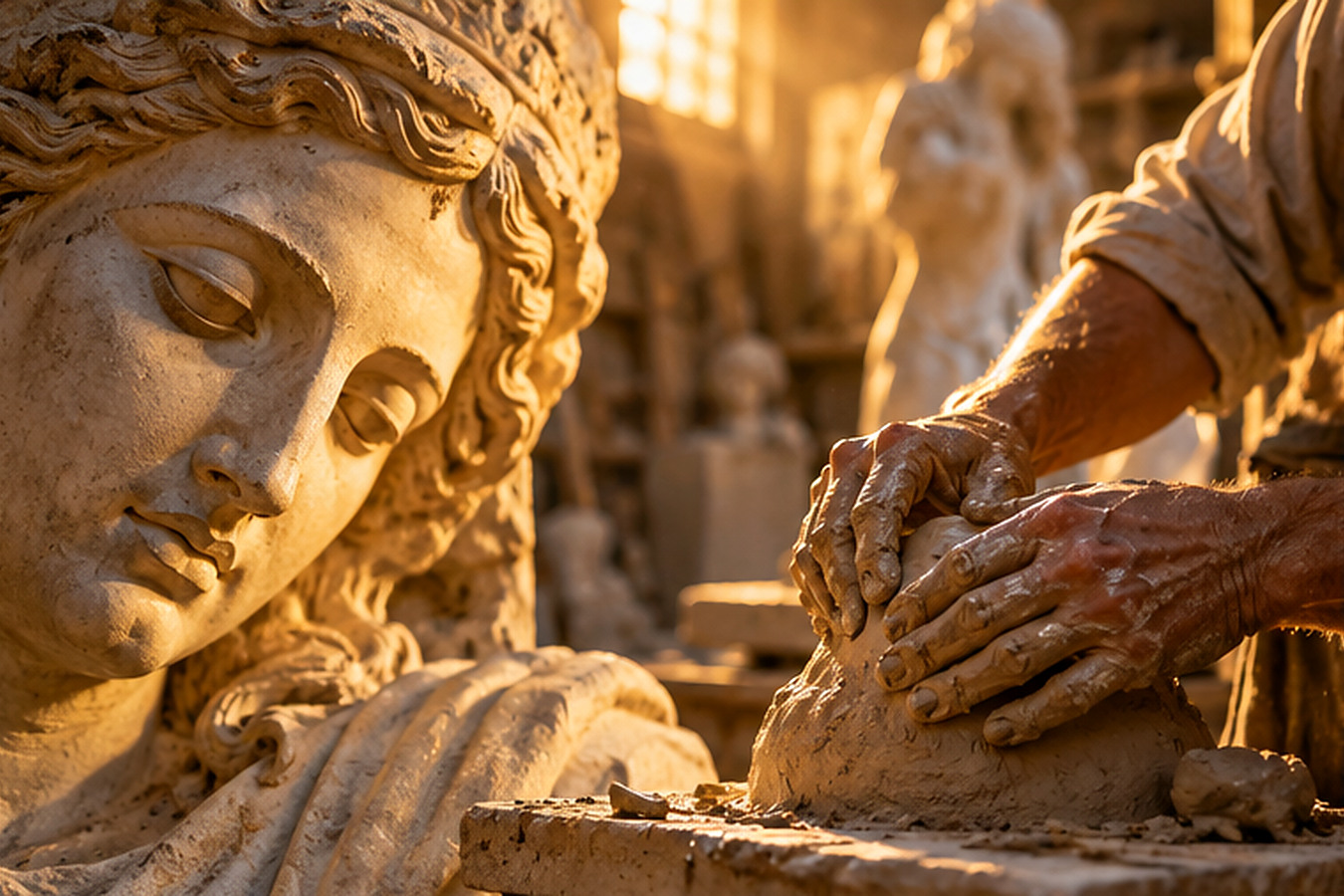
Hands shaping clay beside a classical sculpted face
The maker is not producing something from nothing. Every tradition explored on this page agrees, in its own language, that the artist is uncovering something that was there all along — waiting behind the surface of the ordinary for a human being to pay attention with sufficient depth and care to bring it through. This is why every civilization that has reached toward the sacred has done so partly through art: not because art decorates doctrine, but because it does something doctrine alone cannot. It creates an experience that must be felt in the body, opening dimensions of meaning for which ordinary language has no adequate container. The Psalms are poetry before they are theology. The great cathedrals are sculpture before they are institutions. The chant that rises from a congregation is music before it is prayer — and becomes prayer precisely because it is music.
The artist and the contemplative are engaged in the same work: the patient, courageous attending to what is — until what is reveals itself to be luminous.
What unites these traditions is a conviction that the creative act, entered with full presence and sincere intention, is not merely self-expression. It is a form of encounter — with one's own depth, with the depth of a tradition, with the depth of reality itself. The art that arises from such encounter is recognizable even when it cannot be explained: it moves us not because it is technically accomplished, but because it is true.
* * *
*
THE FIRST PATH — INSPIRATIONAL ART
"Inspiration" comes from the Latin inspirare — to breathe into. In the ancient world, the artist was not the originator of the work but its vessel, the one through whom a larger breath moved to produce something beyond individual capacity. To sit with a blank canvas or a lump of clay and wait, with patient and open attention, for what wants to emerge is a contemplative practice as rigorous as any sitting meditation.
*
THE SECOND PATH — SACRED MUSIC
Of all the arts, music has the most direct access to the interior of a human being. It does not require translation through the intellect; it enters through the body — the ear, the chest, the vibration of bone and blood — and moves us before we have time to think. Sacred music is not simply music with religious content; it is music made in a certain spirit, with the intention of opening the heart to what it cannot hear in ordinary life.
*
THE THIRD PATH — CREATIVE PRACTICE
Creative practice as a spiritual discipline differs from art-making as a professional pursuit in one essential way: its primary aim is not the artifact but the transformation of the practitioner. The pot may or may not be beautiful when it leaves the kiln; what matters is who the potter was becoming during the hours at the wheel — the understanding at the heart of every great tradition of sacred craft.
The most revolutionary act available to a person in a culture of consumption is simply to make something — to put hands to material and bring into existence what did not exist before. Repeated with constancy and intention, this act is one of the most reliable paths to discovering who a person actually is, beneath the accumulated identity of role, history, and expectation.
Traditions of Sacred Making
*
BYZANTINE — THE HOLY ICON
The icon is not a painting but a window. The iconographer fasts and prays, understanding the work as revelation rather than invention.
*
TIBETAN BUDDHIST — SAND MANDALA
Days of intricate sand art, swept away at completion — a teaching on impermanence made visible, the making and unmaking equally the practice.
*
TAOIST — LANDSCAPE & BRUSH
Ink landscape and calligraphy practiced as a discipline of harmony with the Tao, the brush following breath and unforced motion.
*
ZEN — THE WAY OF THE BRUSH
The enso, a circle drawn in a single stroke, is a record of the mind at that moment — imperfect, complete, whole.
*
CHANT ACROSS TRADITIONS
Gregorian chant and Buddhist sutra recitation both use repetition to bypass the intellect and open the heart directly through the voice.
*
MAKING WITHOUT KEEPING
In the spirit of the sand mandala: create with full care, then release — teaching the hands to give without grasping.
Sacred Music Forms
CHRISTIAN MONASTIC — GREGORIAN CHANT
Ancient plainchant developed to fill stone spaces and prepare the heart. Radical simplicity produces spaciousness.
BUDDHIST — SUTRA CHANT
Recitation of scripture paced to the breath, cultivating concentration and compassion in equal measure.
TAOIST — RITUAL INVOCATION
Chant accompanied by bell and drum, aligning the practitioner's breath with the rhythms of the Tao.
Eight Practices to Begin With
01 — MORNING PAGES
Three pages of longhand writing upon waking — uncensored, unedited, unread. Clears the internal channel.
02 — SACRED CHANT
Sustained singing of sacred texts — Gregorian, sutra, shape-note — the voice as instrument of prayer.
03 — CONTEMPLATIVE DRAWING
Drawing without judgment, following the hand. The hand knows things the mind does not; let it speak.
04 — SACRED READING ALOUD
Lectio Divina — slow, devotional reading of sacred texts aloud, letting the words resonate in the body.
05 — CONTEMPLATIVE PHOTOGRAPHY
Walking slowly with a camera as an instrument of attention, letting the eye rest on what calls to it.
06 — DEDICATED STUDIO TIME
Regular time and space for creative work — showing up with the same constancy as meditation or prayer.
07 — MEDITATIVE LISTENING
Listening to sacred music with full, undivided attention, and allowing the music to do its work.
08 — MAKING WITHOUT KEEPING
Create with full care, then release. A sandcastle, a chalk drawing — teaching the hands to give without grasping.
You do not have to be talented. You do not have to have training. What is required is only the willingness to show up to the practice, to engage the materials with genuine attention, and to let what arises, arise. Pick up the brush. Open the throat. Touch the string. Something is waiting to come through.
Thirteen
Epiphany and Inspiration
An epiphany is a sudden clearing of the fog — the moment when something that had been gathering unseen finally breaks the surface into plain recognition.
Radiant sunlight breaking through pastel clouds
Artists, scientists, mystics, and ordinary people across history have described strikingly similar experiences of sudden insight: a melody arriving whole in the mind, an image appearing complete before a single line has been drawn, a difficult problem resolving itself in an instant after months of effort had failed to move it. These moments share a common shape. They rarely arrive from nothing — they follow real labor, real attention, and often real frustration. And they rarely announce themselves in advance; they simply appear, already finished, as though they had been waiting for the mind to become quiet enough to notice them.
The saints called it grace. The poets called it the muse. Whatever name is used, those who have experienced it agree on this much: it cannot be summoned by force, only invited by readiness.
Where Inspiration Tends to Arrive
In silence, after the noise of active effort has finally quieted
While walking, when the rhythm of the body frees the mind
During meditation or prayer, in states of settled attention
In conversation, when another person's words unlock something unexpected
Through reading, when someone else's insight becomes the seed of one's own
In dreams, when the sleeping mind finishes work the waking mind left undone
In the middle of ordinary daily life, without any special preparation at all
What these very different circumstances share is a common thread: each involves a temporary loosening of deliberate control. Active striving is necessary — no insight arrives to a mind that has never engaged the problem — but striving alone rarely produces the breakthrough itself. It is usually the pause after the striving, the walk after the failed afternoon at the desk, the silence after the unanswered question, where the missing piece is finally allowed to surface. This is why so many spiritual traditions treat both discipline and rest, both labor and stillness, as necessary partners rather than opposites.
Fourteen
The Artist as a Seeker
Every honest maker knows the same private companions: doubt before beginning, frustration in the middle, and — if the work is carried through — a quiet joy at the end that is somehow larger than the finished object itself.
Painting supplies and canvas overlooking mountains and an abbey
The Difficulties
The fear of beginning, when the blank page or empty canvas feels larger than any idea brought to it
The fear of being judged, which can silence work before it has even started
Doubt in the middle of the process, when the work looks nothing like what was imagined
Failure that must be faced honestly rather than avoided
Revision, which asks the maker to release an earlier version of the work for the sake of a better one
What the Work Teaches in Return
Patience, learned by staying with something longer than comfort would prefer
Humility, learned by discovering how much correction good work requires
Practiced attention, sharpened every time the eye or ear is asked to notice something small
Courage, built one small act of beginning at a time
The particular joy of completion — not pride exactly, but a quiet gratitude that something now exists which did not exist before
To call the artist a seeker is not to romanticize difficulty. It is simply to notice what the discipline of creative work actually does to a person over time: it makes them more attentive to the world, more patient with imperfection, more willing to sit with uncertainty long enough for something true to emerge from it. This is precisely the shape of a spiritual journey, whether or not the maker ever names it that way.
Fifteen
Sacred Art in the Modern World
Every new tool a culture invents eventually finds its way into the hands of those trying to reach the sacred with it.
Pink lotus blossom illuminated by a modern photographic composition
Digital art, contemporary iconography, photography, film, and music production have each opened genuinely new possibilities for sacred creativity — a modern iconographer can now study centuries of source material in a single afternoon; a small congregation can share its music with the world through a simple recording; a contemplative photographer can capture a single moment of stillness and offer it to thousands. Online worship, virtual museums, and digital archives have made traditions once locked away in distant libraries and cathedrals available to anyone with genuine curiosity.
Artificial intelligence has entered this same long history as one more tool among many — and, like every tool before it, raises real questions alongside its real possibilities. What does authorship mean when a machine assists in generating an image? What is lost, or preserved, when a tradition's visual language is reproduced without the discipline that historically accompanied it? These are not questions with easy answers, and thoughtful communities will continue to work them out. What can be said with confidence is that the underlying human need — to give shape to reverence, to make something worth gathering around — has survived every previous technological shift, from the printing press to photography to recorded sound, and there is good reason to expect it will continue to find its way through this one as well.
Contemporary sacred architecture, independent musicians releasing music directly online, and small parishes livestreaming evening prayer are all, in their own way, doing exactly what the catacomb painters and the monastery scribes did: using the tools available to them to make the sacred visible to their own moment.
Sixteen
Create Your Own Sacred Art
None of this history belongs only to professionals or to the past. It is an open invitation, and the tools required to accept it are almost always already close at hand.
Painter brushes and canvas in a sunlit studio
BEGIN A PRACTICE
Keep a spiritual sketchbook. Write a poem a week. Build a small personal prayer book from words that have moved you.
LEARN A TRADITION
Learn one sacred song by heart. Study calligraphy. Read one book of art history a season.
JOIN SOMETHING
Join a choir, even as a beginner. Visit an old church or temple with real attention. Take a friend or family member with you.
WORK WITH YOUR HANDS
Photograph a place that moves you. Plant a small contemplative garden. Make seasonal decorations by hand.
PAY ATTENTION
Keep a journal of dreams and unexpected insights. Write a short reflection after any moment of real beauty or wonder.
MAKE IT SHARED
Create art together with family or community. A shared creative act often becomes the memory a group returns to for years.
None of these practices demand talent as a precondition — only attention, regularity, and a willingness to begin imperfectly. Sacred creativity has never belonged exclusively to masters; it belongs to anyone willing to make something with care.
Seventeen
A Gallery of Sacred Traditions
A field guide to the traditions explored throughout this page — each a door into a much longer story of its own.
Byzantine sacred art mosaic with golden tesserae
CHRISTIAN ART
From catacomb symbol to cathedral glass — a tradition built on the incarnation made visible.
BYZANTINE ICONS
Windows onto eternity, painted according to a disciplined, prayerful tradition.
SACRED MANUSCRIPTS
Scripture turned into an art of pigment, gold leaf, and monastic devotion.
CATHEDRALS & ARCHITECTURE
Stone and glass arranged to draw the body's attention upward.
BUDDHIST ART
Image and mandala as a map toward awakening and compassion.
TAOIST ART
Landscape and calligraphy as a practice of harmony with the Tao.
CHANT
Unmetered melody built to carry text, breath, and stillness together.
CHOIRS & HYMNS
The congregation's own voice, trained and offered back to itself.
GOSPEL & CONTEMPORARY WORSHIP
Living, evolving traditions of praise built from suffering and joy alike.
Eighteen
Beauty as a Path
Beauty interrupts. That is, quietly, its whole power.
Mountain lake mirrored in quiet pink sunrise
In the middle of an ordinary day, art can cause us to pause. A half-remembered melody can awaken a memory thought long buried. A single sacred image, glimpsed without warning, can invite a moment of contemplation that no argument could have produced. A choir, however small, can turn a room of separate voices into a single sound larger than any one of them alone. And every so often, a creative act reveals to its own maker something they did not fully understand until the work itself brought it into view.
This is the thread that runs unbroken from the ochre handprint in a dark cave to a congregation's hymn sung tonight, from a medieval scribe's gold leaf to a musician's newly released recording, from a carved stone temple to a small chapel of plain wood and a single window of light. Ancient chant and digital music. Illuminated manuscript and contemporary painting. Vast cathedral and modest community garden. All of it belongs to one long, unfinished human story: the story of a species that has never stopped reaching past ordinary words in search of the eternal, and that has never stopped finding, again and again, that beauty is one of the truest ways to get there.
The work continues. Every generation adds its own verse to a song that began before memory and will not end with us.
Nineteen
Resources: Where to Find What You Need
None of the art, music, or practice described on this page requires a large budget or a professional institution behind it. Most of it is already available, freely and legally, to anyone willing to look.
Antique devotional book open beside candle and wooden cross
Individuals and small communities can begin with public-domain artwork and recordings from major museums, libraries, and archives — most of which now offer open digital access to enormous portions of their collections. What follows is a practical map of where to look, organized by kind, along with the basic rules for using what you find with both legal safety and genuine respect.
Art Resources
CLASSICAL RELIGIOUS ART
Renaissance, Baroque, and medieval masterworks through museum open-access programs and art-history archives.
CHRISTIAN ICONS
Byzantine and Orthodox icons, widely available as public-domain reproductions and through monastery collections.
ILLUMINATED MANUSCRIPTS
The Book of Kells, the Lindisfarne Gospels, and others digitized by major university and national libraries.
BUDDHIST ART
Thangkas, statues, and mandalas through dedicated Himalayan and Buddhist art digital collections.
TAOIST ART
Landscape painting and calligraphy through Chinese museum archives and online galleries.
FOLK, VISIONARY & MYSTICAL ART
Self-taught and devotional folk painting, held by dedicated folk-art museums and galleries.
CONTEMPORARY SPIRITUAL ART
Living artists exploring the sacred today, found through independent gallery platforms and local exhibitions.
STAINED GLASS, SCULPTURE & ARCHITECTURE
Photographs and virtual tours offered directly by many great cathedrals and sacred sites.
Building a personal or community collection: gather images that resonate with your own practice, and use them for study, contemplation, or display. Always verify a work's copyright status before printing or projecting it, and hold every image with awareness of the tradition it comes from and the meaning it carries there.
Music Resources
GREGORIAN CHANT
Monastic recordings and manuscripts held in dedicated chant archives and abbey collections.
CHRISTIAN HYMNS
Public-domain hymnals and modern collections, widely available online and through secondhand booksellers.
SACRED CHORAL MUSIC
From Palestrina to the present, through public-domain choral score libraries offering thousands of free scores.
GOSPEL MUSIC
Historical recordings and sheet music preserved in major national folk-music and heritage archives.
ORTHODOX & BYZANTINE CHANT
Greek and Slavic chant traditions, often shared directly by monastic communities online.
BUDDHIST & TIBETAN CHANTING
Monastic recordings and ritual music through dedicated Buddhist resource archives.
MEDITATIVE & AMBIENT MUSIC
Contemporary contemplative work, frequently released under open licenses by independent musicians.
A Resource-Finding Guide
Begin close to home: local public libraries offer books, recordings, and often free access to research databases; university libraries frequently allow community members on-site use of their collections; museums and archives increasingly digitize and share their public-domain holdings outright. Use specific search terms — a tradition or work's name alongside "public domain" or "free score" — rather than broad ones, and don't overlook used bookstores, thrift stores, and community art centers, which often hold inexpensive hymnals and art books no archive has catalogued.
Public Domain & Copyright
A work enters the public domain once its copyright expires and may then be used freely. Creative Commons licenses permit use under stated conditions such as attribution; fair use permits limited use for teaching, criticism, or scholarship, but is not blanket permission. When in doubt, look for a work clearly marked public domain or Creative Commons, provide attribution where asked, and remember that legal permission and cultural respect are two different, and both necessary, things.
Building a Personal or Community Sacred Library
A growing collection is only as useful as its organization. Physical items keep best in labeled binders, file boxes, and a dedicated shelf; digital files benefit from a clear, consistent folder structure sorted by tradition and form, backed up in more than one place. A simple running catalogue — even a single notebook noting what you have and where it lives — saves hours of searching later, and for a shared community library, one clearly designated shelf or folder with agreed access keeps the collection useful to everyone rather than lost in any one person's files.
Almost none of this requires a budget. Public-domain scores, library songbooks, open-access museum images, and a cappella singing together cost nothing at all — and are often exactly where the richest material is hiding.
Twenty
The Sacred Streets — A Closing Word
Inspiration does not belong only in museums. It belongs wherever people gather, struggle, dream, pray, create, and awaken.
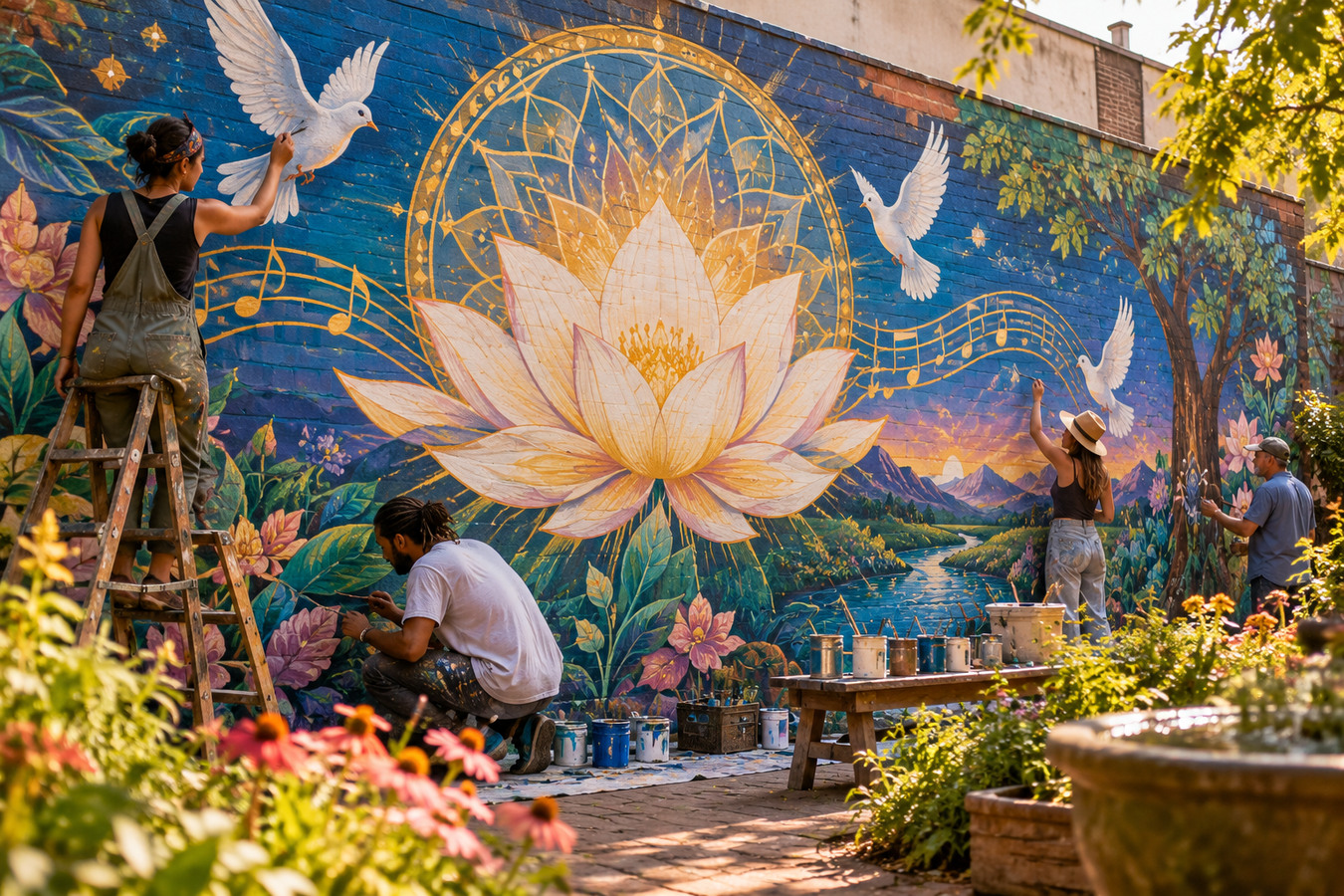
Artists creating a colorful public lotus mural with peaceful doves
The Art of the Streets
Street art, made with permission and respect, transforms ordinary walls into open-air galleries. Murals tell a neighborhood's history, its hopes, and its struggles; posters and stickers carry messages that might otherwise go unheard; community art invites everyone, not only the trained, to leave a mark on the world. The distinction that matters is consent: destructive vandalism defaces property without it, while lawful, invited, community-supported art beautifies a shared space with the blessing of the people who live there.
Across the world, artists have turned forgotten walls and empty lots into places of reflection — a mural of a saint on a brick wall, a mandala painted on a sidewalk inviting mindful walking, a community garden fence covered in handprints and names. Street art reminds us that beauty needs no ticket. It belongs to whoever walks past it on the way to work or school, and it can change how a whole neighborhood sees itself.
A wall is only a barrier until someone paints a doorway on it.
Cheap Art, Great Ideas
Creativity has never depended on the price of materials. A piece of cardboard becomes a canvas; a broken chair becomes a sculpture; a scrap of fabric becomes a banner. Thrift stores, garage sales, recycling centers, and community donation bins are treasure troves for the imaginative maker, and nature itself provides — fallen leaves, stones, twigs, and pinecones can all become part of a sacred composition.
Find old paintings secondhand; paint over sections or add collage elements, letting the earlier work show through in layers of history.
CARDBOARD CANVASES
Cut and gesso cardboard panels for practice, experimentation, and community art projects at almost no cost.
ASSEMBLAGE ART
Combine discarded objects — nails, keys, broken toys, bottle caps — into sculpture that turns the discarded into the sacred.
The Secondhand Sacred
Thrift stores, flea markets, and estate sales hold objects that have outlived their original owners — old religious images, forgotten paintings, worn prayer books — waiting for someone to see their potential rather than their wear. A cracked plaster statue, repaired and regilded, becomes something new; an old wooden cross, refinished, speaks again across generations. When working with objects from a living tradition, research their original meaning first, and consider whether restoration, rather than transformation, is the more respectful act. The objects you rescue are not just materials — they are witnesses, present in other prayers and other lives before yours.
Art as a Message
A painted dove can speak of peace without a single word; a poster carrying one word — hope, justice, remember — can turn an ordinary walk into a moment of reflection. Art can be a visual sermon, a blessing, a question, or an invitation, because it bypasses argument and speaks directly to the heart.
HOPE
Dawn, seeds, and birds in flight — art that says simply: keep going.
COMPASSION
Reaching hands, open hearts, the face of the stranger given dignity.
JUSTICE
Scales, raised hands, open books — the voice of the voiceless made visible.
THE SACRED EVERYDAY
The table, the garden, the shared cup of tea — ordinary life honored as holy.
Religion Beyond the Building
Spirituality has never been confined to temples and churches. It erupts in a community garden where neighbors plant together, in a public mural of the Buddha reminding passersby of stillness, in a sculpture of the Madonna offering comfort to the weary in a public park. Christian light and resurrection, Buddhist serenity and mandala, and Taoist mountain and water each speak their own language outside institutional walls, and universal symbols like the dove and the open hand bridge them without need of translation.
Parks, Streets, and Hidden Creative Spaces
Creativity hides in plain sight: an authorized community mural telling a neighborhood's story, a small art table set up in a park on a Sunday afternoon, a converted garage serving as a gallery for local makers. These places are rarely glamorous, but they are alive — the hidden nervous system of the creative world, where art is made not for money or fame but because the human spirit demands it. Ask at a local community center, watch for posters on telephone poles, and knock on the door of that converted garage; the creative underground is waiting to welcome anyone who looks for it.
The DIY Artist
You do not need permission to be creative. You do not need a degree, expensive materials, or anyone else's validation of your vision — only the willingness to begin. Start small: a painted cardboard panel, a collage from old magazines, a hand-lettered poster. The one real requirement, when the canvas becomes someone else's wall or a shared public space, is to ask first, collaborate honestly, and respect the space and the people who live around it. The world does not need more perfect art. It needs more honest art — made by real people, trying to tell the truth of their own experience.
* CREATE SOMETHING TODAY *
Paint a small cardboard panel with a word of hope.
Art in the Alley of the Soul
Every human being carries an alleyway inside — the place where broken dreams and forgotten parts of the self gather dust, avoided and unacknowledged. But the alley is not only shadow; it is also, unexpectedly, a place of light. A cracked pot mended with gold becomes more beautiful for having broken. A torn photograph, pieced back together, becomes a new memory. The artist who learns to see potential in a broken object also learns to see potential in themselves — an act of creation from the discarded that is, quietly, an act of self-acceptance.
The stone the builders rejected has become the cornerstone.
Community Wall
Art reaches toward others even when made alone. Imagine a wall in your own neighborhood where anyone can hang a painting, a poem, or a photograph; a monthly market where artists trade work instead of money; a garden where sculpture made from recycled materials stands among the vegetables. These things already exist, in communities around the world, built by ordinary people who decided art should belong to everyone. Start your own — find a wall, a community center, a church basement, a school hallway — and keep it simple, open, and alive.
"I don't buy art supplies. I find them. The city gives me everything I need — discarded wood, old paint, broken things. My job is to see the beauty that's already there, waiting to be noticed." — Artist Spotlight: The Found-Object Visionary
ARTIST SUBMISSIONS
Open walls for anyone to share their work, regardless of experience or training.
AFFORDABLE ART EXCHANGES
Trade paintings, prints, and crafts directly with other local makers.
FOUND-OBJECT GALLERIES
Exhibitions built entirely from recycled and discarded materials.
* * *
The Art Revolution
Art is not the exclusive property of wealthy collectors, museums, or elite institutions. It belongs to children, elders, workers, students, mystics, dreamers, musicians, poets, street artists, gardeners, religious communities, and anyone with something meaningful to express. Every act of creation is an act of hope. Every work of art, however humble, is a small stand against the idea that we are not enough.
Make something beautiful. Leave something inspiring. Turn an ordinary space into a moment of reflection, and let creativity remind the world that the human spirit is still alive.