The Pure Land Understanding: of the Golden Flower Abbey Of the White Lotus Society
On the theological identity of the Logos, Jesus as the Word of God, and Amitabha Buddha, Lord of Infinite Light and Life
Featured Volume
Pure Land Buddhism
A White Lotus Society Perspective
By Terry Evans
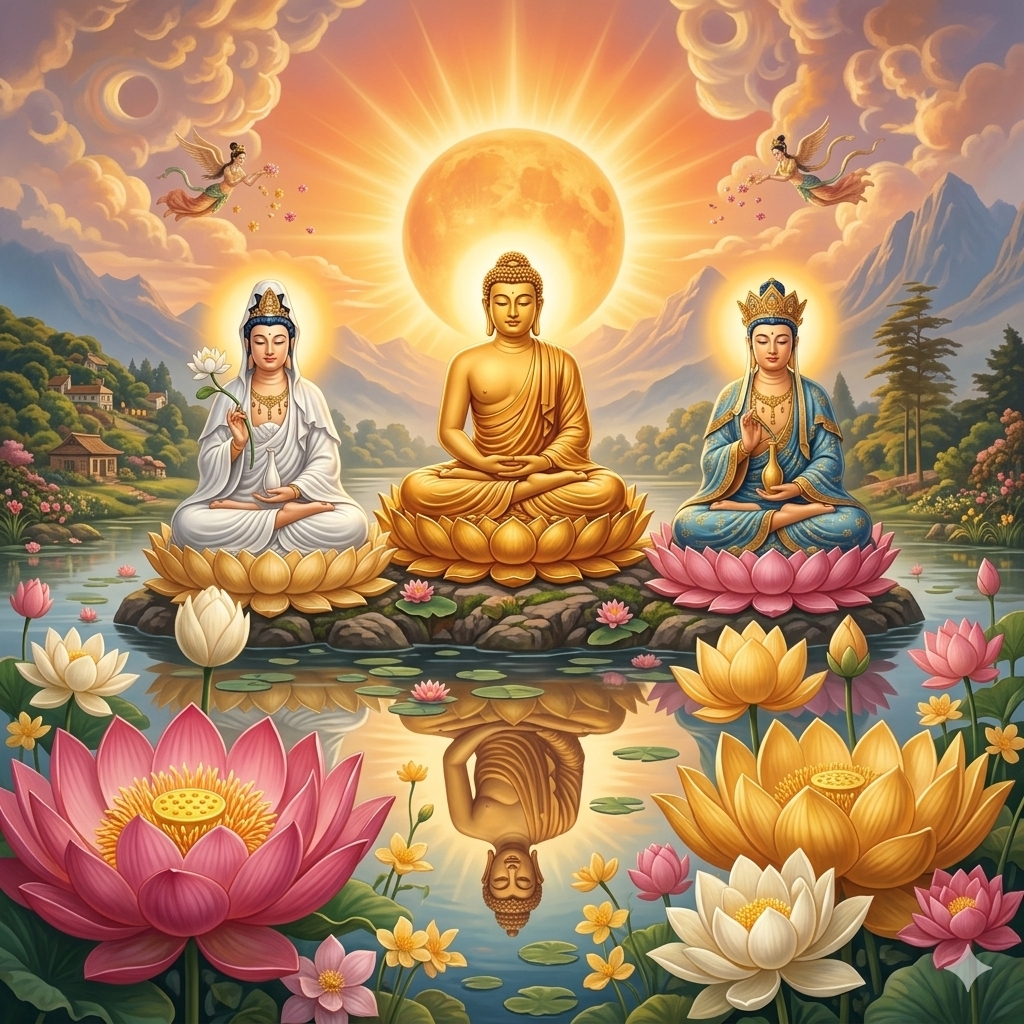
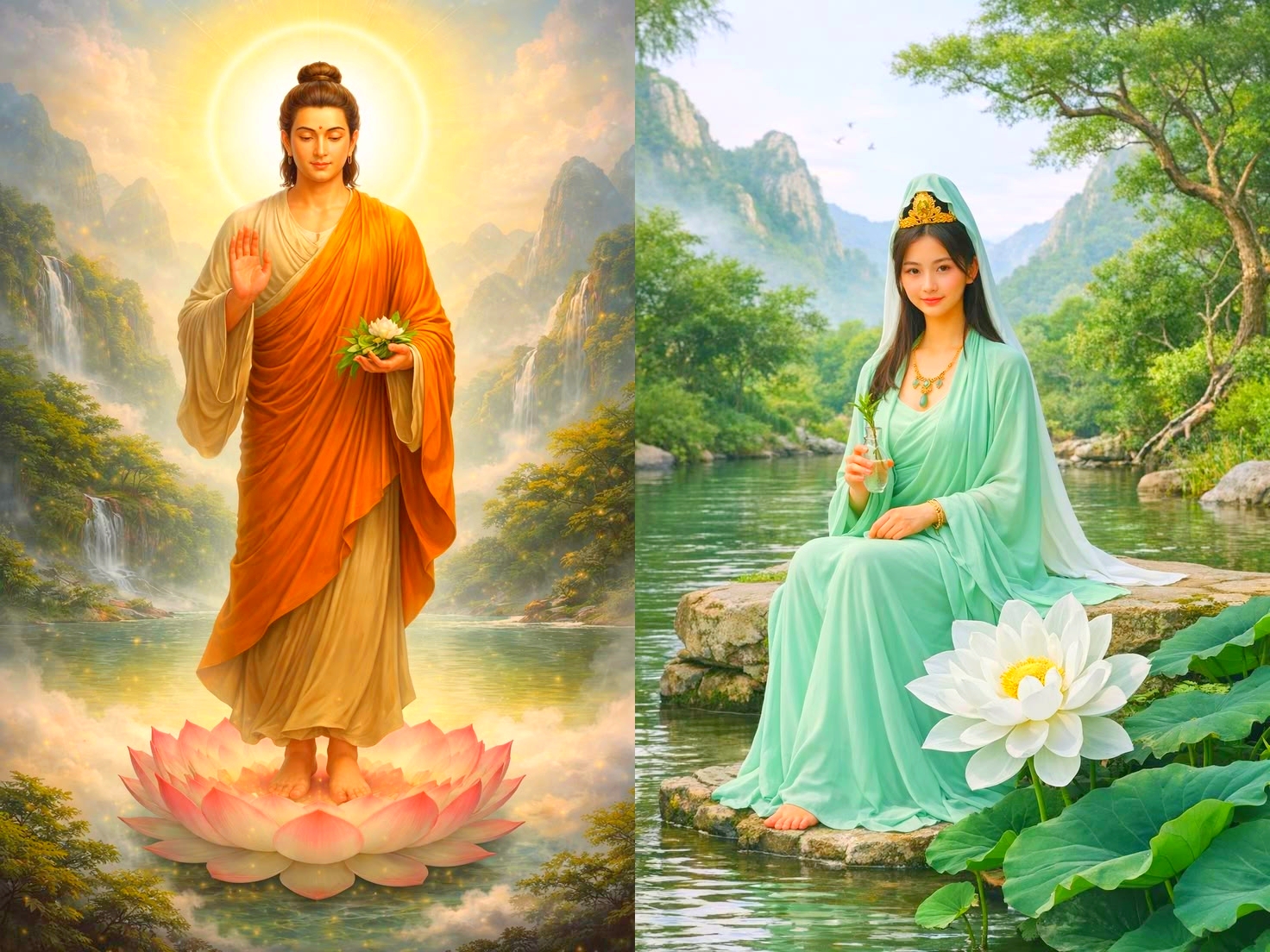
The path of Other Power, in which the compassion of Amida Buddha carries every being. Here the Pure Land, the Tao, and the Gospel flow together as one river, and four friends gather at the tea table to speak with a single voice of grace, trust, and the light that never abandons anyone.
There is a truth so vast that it has spoken itself into human consciousness through multiple streams,
wearing different names and robes in different lands, yet remaining one and the same reality.
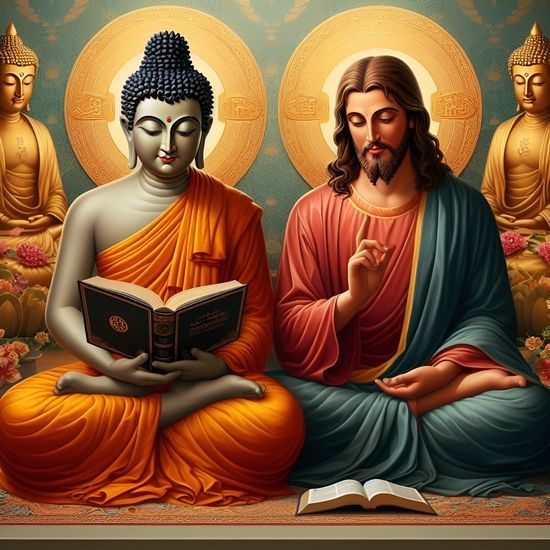
The Logos of Greek philosophy and Christian theology, Jesus as the Word of God incarnate,
and Amitabha Buddha, the Lord of Infinite Light and Life — these are not merely similar teachings
pointing vaguely in the same direction. They are the same living reality, the same divine principle,
expressing itself through the vessels available to each civilization.
Pure Land Buddhism centers on unwavering faith in Amitabha, the Buddha of Infinite Light and Infinite Life.
Eastern Christianity, particularly through Hesychasm and the Jesus Prayer, turns with absolute faith toward
the Uncreated Light of Christ. Both traditions are built upon a loving relationship with a radiant,
compassionate savior figure — accessed through a simple, heartfelt invocation — leading the faithful
soul toward a guaranteed, blissful union in a realm of perfect light.
To see them as separate is a failure of depth, not a sign of rigor.
The universe did not produce two infinite lights.
✦
I The Light and the Life: Two Names, One Reality
The Logos, as Heraclitus first articulated and as the Stoics developed, is the rational principle that underlies,
pervades, and orders all existence. It is not a god among gods but the very intelligence woven into the fabric of
reality itself — the reason why the cosmos is a cosmos and not chaos. When the Gospel of John opens with
“In the beginning was the Logos, and the Logos was with God, and the Logos was God,”
it makes a staggering claim: that this universal ordering principle is not merely an abstract force but a divine
person — a living being who is simultaneously the source of all light and the ground of all life.
The Logos is described as that through which all things were made, and in whom is the life that is the light
of humanity. Light and life. These are the two defining attributes of the Logos made flesh.
Now turn to the East. Amitabha, whose name in Sanskrit literally means Infinite Light,
is also called Amitayus, meaning Infinite Life. He is the buddha of the western direction,
and his pure land, Sukhavati, is described in the sutras as a realm of inexhaustible radiance where all beings
who reach it continue in perfect awakening without end. The Larger Sukhavativyuha Sutra describes how
Amitabha’s light penetrates every world without obstruction, touching every being without exception,
turning toward all who call upon him with sincere heart.
“In him was life, and the life was the light of men. The light shines in the darkness,
and the darkness has not overcome it.”
John 1:4–5
The correspondence is not metaphorical. It is structural and essential. Both figures carry precisely
the same two attributes — infinite light and infinite life — as their core identity. No other
divine figure in any tradition is simultaneously named for both. This is the first and deepest sign that
what is being described, across two civilizations separated by thousands of miles, is the same single reality.
Attribute
Logos / Jesus (Christianity)
Amitabha Buddha (Pure Land)
Infinite Light
The light of the world; the Uncreated Light of Tabor; enlightens every person
Amitabha = Boundless Light; light penetrates all worlds without obstruction
Infinite Life
I am the resurrection and the life; eternal life given freely
Amitayus = Boundless Life; pure land where awakening is without end
Universal Reach
All who come to him he will in no way cast out; draws all people
Eighteenth vow: no being sincerely turning toward him is excluded
Salvation by Grace
Not by works but through faith; grace is the gift of God
Other-power (tariki); liberation through the buddha’s vow-power, not personal merit
The Name as Portal
The name of Jesus invoked in the Jesus Prayer; name above every name
Nembutsu: Namu Amida Butsu; the name carries the full reality of the buddha
✦
II The Logic of Grace: Reaching Across the Infinite Distance
He made forty-eight vows before his enlightenment, the most essential of which is the eighteenth:
that any being in any realm who sincerely entrusts themselves to him and calls his name will be received
into his presence and liberated. This is grace. This is precisely grace — unearned, unconditional,
rooted entirely in the inexhaustible compassion of the one who offers it.
The theological structure here is identical to that of the Logos in its Christian expression.
Jesus, as the incarnate Word, declares himself to be the light of the world and the life of the world.
He says that he stands at the door and knocks, that all who come to him he will in no way cast out,
that the Father draws all people to him. The entire logic of Christian salvation through Christ is that
the human being cannot, through their own effort, cross the infinite distance between the conditioned self
and the unconditioned divine. Something from the divine side must reach across. The Word must become
flesh. The light must descend into the darkness and illuminate it from within.
This is exactly the logic of Amitabha’s compassion reaching out through the nembutsu —
through the practice of calling his name, Namu Amida Butsu — so that it is not ultimately
the practitioner’s achievement that brings liberation but the buddha’s own vow-power,
his pranidhana, working through the sincere and trusting heart.
Christian Grace
The divine descends as the incarnate Word. Faith itself is a gift of grace — the Augustinian and
Lutheran understanding that the will turned toward God is already God’s own working in the soul.
The human contributes nothing except the openness to receive.
Pure Land Other-Power
Shinran Shonin taught that even the faith with which a person turns toward Amitabha is not their own
production but a gift of the buddha’s compassionate working within them. The human contributes
nothing except the openness to receive.
The divine does not wait for human beings to generate sufficient merit or spiritual capacity.
The divine generates the very capacity for response within the human being and then responds to
what it has itself generated. This is the circle of grace, and it turns with the
same motion in both traditions — described by Shinran in medieval Japan and by Augustine in
fifth-century North Africa, without either knowing the other, because they were each describing
the same infinite light from different hillsides.
“Even a good person attains birth in the Pure Land, so it goes without saying
that an evil person will.”
Shinran Shonin, Tannishō
III The Pure Land and the Kingdom of Heaven
The Pure Land itself — called Sukhavati, the Land of Bliss — is described in
the sutras with extraordinary vividness: jeweled trees, lotus ponds, birds that speak the Dharma,
an atmosphere of perpetual clarity and peace. In Mahayana Buddhism, a Buddha-field is a realm shaped
by the merit and intention of a fully enlightened being — an environment stripped of every obstacle
to awakening. There is no poverty, no illness, no false teaching, no distraction.
In its deepest reading, the Western Pure Land is not a physical location somewhere beyond the setting sun.
It is the field of Amitabha’s enlightened awareness, the dimensionless space of infinite compassion
opened up by his vow. To be born into the Pure Land is to be born into awakening itself, into the life
that does not end and the light that does not diminish.
This is structurally and experientially continuous with the Christian mystics’ understanding
of union with the Logos — Meister Eckhart’s birth of the Word in the soul, the Eastern
Orthodox vision of theosis, the deification of the human person through participation in divine
light and life. The Hesychast tradition of the Eastern Church speaks of the uncreated light,
the divine radiance that transformed Christ on Mount Tabor and that the contemplative can come to perceive
and participate in. This uncreated light is the same reality as the amita, the infinite,
immeasurable light that is Amitabha’s very being.
“Blessed are the pure in heart, for they shall see God.”
Matthew 5:8
Both destinations — the Pure Land and the Kingdom of Heaven — are not escapist fantasies
but descriptions of a state of being in which every obstacle to full awakening is removed. Both are
entered not through personal achievement but through the reception of grace. And in both, the light
encountered there is not created or earned — it is the original light, the primordial radiance
that was present before the worlds began, now made available to every being willing to turn toward it.
✦
IV The Eightfold Path and the Beatitudes: One Interior Map
Across centuries and continents, the world’s great wisdom traditions have arrived at strikingly
similar answers to humanity’s oldest question: How should one live? Buddhism’s
Noble Eightfold Path and Christianity’s Eight Beatitudes offer a remarkable example of this convergence.
Both emerged from different worlds — one from the forests of ancient India, the other from the hillsides
of first-century Judea — and yet they describe the same interior journey with uncanny precision.
Both begin not with outward behavior, but with a fundamental shift in how one sees. The Eightfold Path
opens with Right View — the capacity to perceive reality as it actually is.
The Beatitudes open with “Blessed are the poor in spirit” — an emptiness
of pride that mirrors Right View precisely. Both paths then move outward into ethical life, and both
culminate in a purification of perception that opens onto the vision of ultimate reality itself.
Right View & Intention
Clear seeing of reality as it is: impermanence, suffering, interdependence. Corresponds to “Blessed are the poor in spirit” and “Blessed are those who mourn” — the willingness to meet reality without denial or escape.
Right Speech, Action & Livelihood
Truthfulness, non-harm, compassionate conduct. Corresponds to “Blessed are the meek,” “Blessed are the merciful,” and “Blessed are the peacemakers” — the outward expression of an inwardly awakened life.
Right Effort & Mindfulness
Clear, non-reactive, present-moment awareness. Corresponds to “Blessed are those who hunger and thirst for righteousness” — a sustained orientation of the whole person toward what is real and good.
Right Concentration
Single-pointed absorption, the gathered and stilled mind. Corresponds to “Blessed are the pure in heart, for they shall see God” — the purified perception that opens at last onto the vision of ultimate reality.
The deepest convergence comes in the cultivation of inner qualities. Right Mindfulness —
the practice of clear, non-reactive, present-moment awareness — corresponds exactly to “Blessed
are the pure in heart.” Purity of heart means a perception unclouded by self-deception and ego,
a seeing that is fully awake to what is actually there. Both traditions promise that this purification of the
mind leads at last to a vision of ultimate reality — whether that reality is called Nirvana, the Kingdom
of Heaven, or simply the infinite light that was always already shining.
✦
V The Name as Living Contact
In Pure Land practice, the nembutsu — the recitation of Amitabha’s name — is not
a technique for generating spiritual merit. It is a way of allowing the reality of Amitabha to resonate
through the practitioner, a way of opening to the light already present. The name is not a label pointing
at an absence. It is a living point of contact with a living presence.
In Christian practice, the invocation of the name of Jesus carries the same understanding in its depths.
The Jesus Prayer — “Lord Jesus Christ, Son of God, have mercy on me” —
is not a mere request. It is a means of drawing divine grace directly into the heart. The name is not a magic
formula but a living portal to the living Logos, a way of turning the whole person toward the light that is
always already shining.
The name and the reality named are inseparable in both cases because the divine being in question is not
distant but intimately present — closer than breathing, waiting only for the turning of attention.
Namu Amida Butsu and Lord Jesus Christ are two syllable-strings pointing at the same
infinite source. The practitioner who recites either with a sincere heart is doing the same thing:
opening a window in the self through which the light that is always already there can pour in.
“With the arising of Right View comes the arising of the path.”
Samyutta Nikaya 45.1
✦ ✦ ✦
VI The Divine Feminine: Guan Yin, Mary, and Divine Sophia
This lineage of grace extends naturally to the divine feminine, where figures of compassionate wisdom
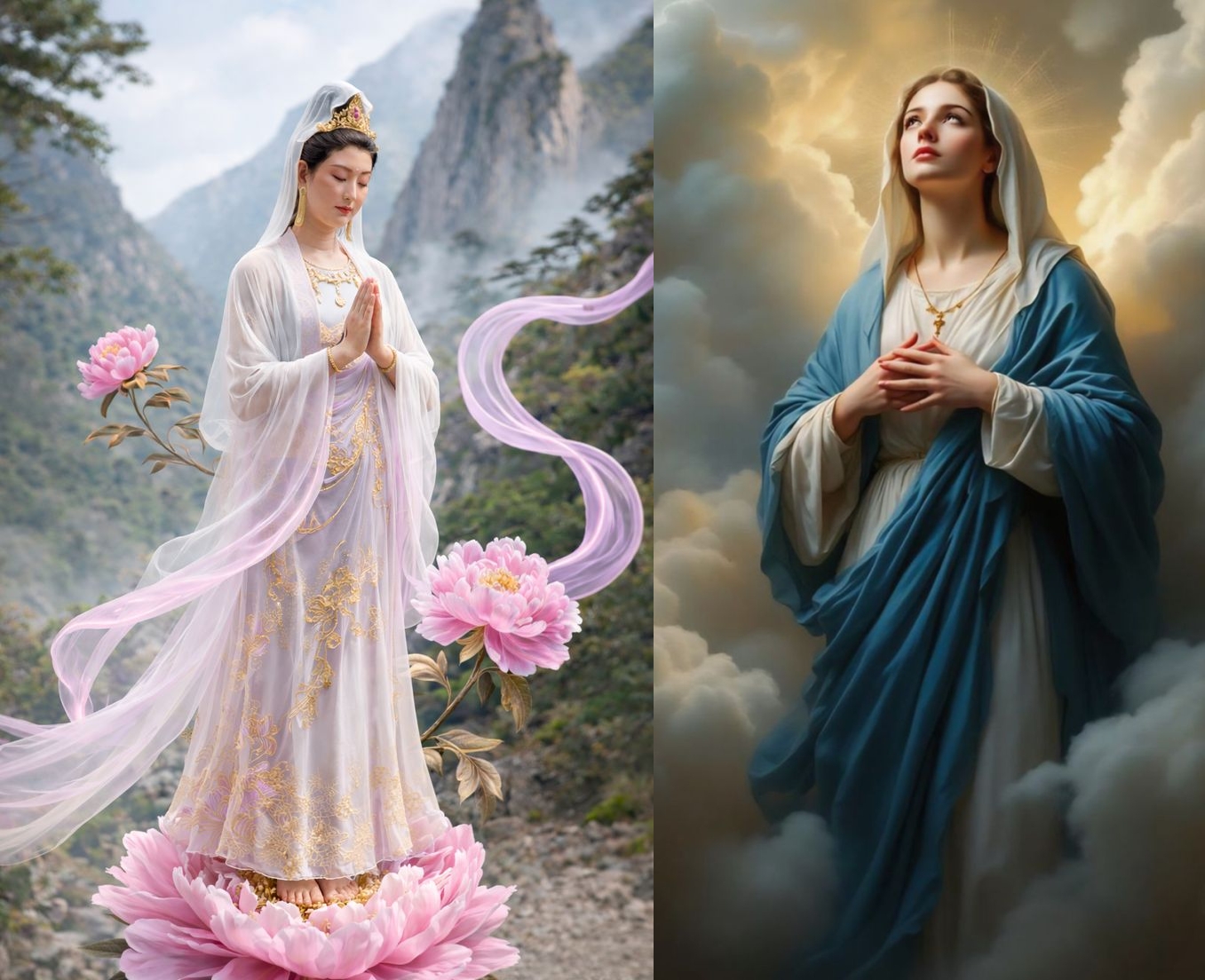
appear across traditions as the nurturing face of the infinite. In Pure Land, Guan Yin
(Avalokitesvara), the bodhisattva of compassion, serves as the radiant attendant to Amitabha, actively
guiding beings toward the Western Paradise with motherly care. Her name means “one who hears the cries
of the world.” She turns toward every being in distress without exception.
The White Lotus Society, a historic Pure Land movement, venerates the Great Mother as the womb of
enlightenment — the pure wisdom from which faithful rebirth emerges. This corresponds directly to
Eastern Christianity’s Divine Sophia, the personified Wisdom of God through whom
all creation is sanctified, and the Theotokos — Mary the Mother of God —
who is the bridge between heaven and earth, the pure vessel through which divine light enters the world,
interceding constantly for humanity.
In both visions, the feminine represents the receptive, nurturing aspect of the absolute —
the compassionate refuge, the one who hears the cries of beings and guides them safely home to the realm
of uncreated light. Guan Yin and Mary are not competing figures but complementary expressions of the same
maternal compassion streaming from the same infinite source: the inexhaustible mercy of the light
that will not abandon any being.
✦
VII One Light, Many Names
What prevents people from seeing this identity is not genuine theological difference but the accumulated
weight of institutional boundary-marking — the very human tendency to protect the particular form
in which truth has been received by declaring all other forms lesser or false. Traditions build walls
around their treasures. But the infinite light does not honor those walls. It shines through every window
that is opened to it, and it shines with the same light through all of them.
Both figures — the Logos and Amitabha — are characterized by the same three essential
qualities: they are the source of primordial light, they are the ground of inexhaustible life, and they
reach toward the beings who cannot reach them. The Logos enlightens every person coming into the world,
as John writes — not some, not the deserving, but every person. Amitabha’s light shines
without obstruction on all worlds and all beings, and his vow excludes no one who sincerely turns toward him.
The movement in both cases is from the infinite toward the finite, from the unconditioned toward the conditioned,
from the deathless toward those caught in death.
And in both cases, the response asked of the human being is not achievement but trust, not earning
but receiving, not conquest but surrender into a light already shining. Pure Land Buddhism, far from
being a devotional shortcut, offers one of the tradition’s richest meditations on this truth.
It asks: what does the path look like for a being who is limited, burdened, and finite. And it answers:
the path looks like turning toward the light with whatever you have.
Amitabha and the Logos, Infinite Light and the Word who is the light of the world, are one and the same
outpouring of the divine toward the finite — one and the same inexhaustible life offered to all who
will receive it — wearing different names because it has spoken itself into different ears, but
remaining in its own nature perfectly, unalterably one.
The universe did not produce two infinite lights.
There is one light, and it has many names,
and all the names point to the same radiance
streaming from the same inexhaustible source,
calling every being home.