*
Preparing the sacred calendar…
Seasonal ceremonies, devotional practices, and 366 days of feasts, recipes & traditions that sanctify our time
* * *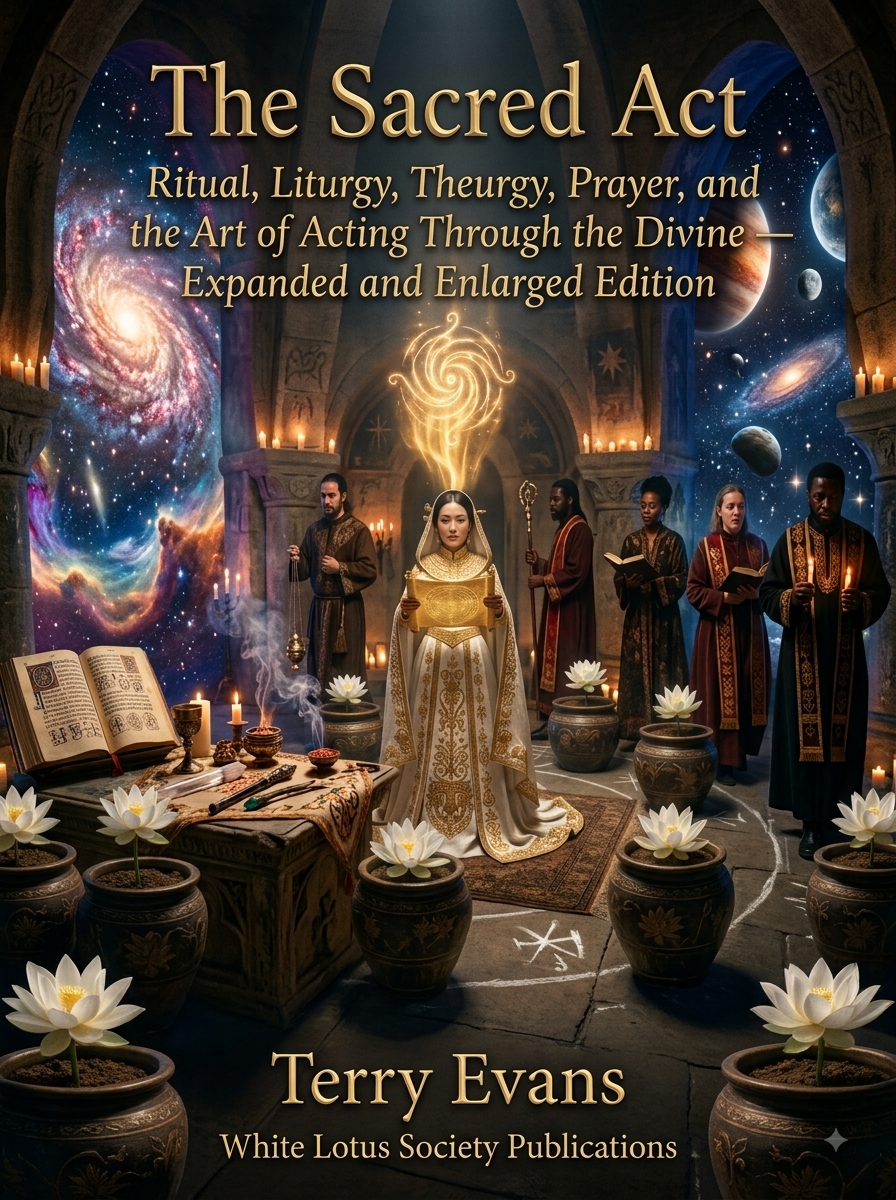
Ritual, Liturgy, Theurgy, Prayer, and the Art of Acting Through the Divine
The companion volume behind the practices explored on this page — an expanded and enlarged edition by Terry Evans tracing ritual from Iamblichean theurgy to comparative liturgy, sacred architecture, and the psychology of ceremony itself, across the world's great devotional traditions.
Download the EPUB *In the unceasing rush of modern life, time has become something to be managed, optimized, and consumed rather than inhabited with reverence. Yet for millennia, human beings have understood something profound: that time is not merely a neutral container in which events occur, but a living fabric woven through with meaning, with sacred possibility, and with the divine. Ritual and liturgy are humanity's most ancient technologies for entering into that meaning — for transforming ordinary hours into hallowed ones, and ordinary lives into consecrated offerings.
To speak of ritual is to speak of intentional, repeated action invested with significance beyond its outward form. The lighting of a candle at dusk, the blessing of bread before a meal, the bowing of the head in prayer at the turning of day — these are not merely customs or habits. They are acts of orientation, ways of reminding the body, the mind, and the spirit that we are not adrift in an indifferent universe but woven into a larger story, a cosmic order that holds us and calls us forth.
Liturgy — from the Greek leitourgia, meaning "the work of the people" — is the communal shape that ritual takes. Where private devotion is intimate and personal, liturgy is public and participatory. It is the voice of a people singing together across centuries, the grammar of a spiritual tradition articulated in gesture, word, song, and silence. To enter into liturgy is to step into a river of prayer that began long before us and will continue long after — a tradition that carries us, even as we carry it forward.
The rhythm of sacred time does not ask us to escape the world, but to see it — and ourselves — more truly.
At the heart of both ritual and liturgy is the concept of sacred rhythm — the understanding that time moves in cycles, not merely in a straight line toward some distant horizon. The turning of the seasons, the waxing and waning of the moon, the daily arc of the sun from darkness to light and back again: all of these natural rhythms have served, in every culture and tradition, as the skeleton upon which devotional life is hung. To follow a sacred calendar is to align one's inner life with the great movements of the cosmos, to participate in the renewal that creation itself perpetually enacts.
Rites of planting, blessing, and resurrection. The earth stirs from its long rest; light overcomes darkness. Ceremonies of cleansing prepare both soil and soul for what is to come.
Festivals of radiance and fruition. The sun reaches its height; the world is in full flower. Liturgies of gratitude and offering honor the fullness of life freely given.
Celebrations of gathering and letting go. What was planted is now harvested; the light begins to recede. Ceremonies of thanksgiving make holy the work of our hands.
Sacred vigils and festivals of light in the deep night. The long darkness calls us inward; we tend the fire and await the return of the sun. Rites of hope are practiced most fiercely in the depths of cold.
Consecrate the day before it begins. A few moments of silence, a psalm, an offering of the hours ahead. This small act reorients the soul toward what matters.
A brief pause at midday — even a single breath of awareness — recalls the heart to its center. In the middle of activity, we touch stillness.
Gather the fragments of the day into gratitude. Notice where you were present, where you resisted, where grace appeared. Lay the day gently down.
Liturgy is not a performance but a participation. When a community gathers to sing, to kneel, to speak the ancient words together, something larger than any individual is enacted. The liturgy forms us — bending our hearts toward mercy, stretching our imaginations toward justice, and training our bodies in the postures of reverence. In an age of radical individualism, gathering for liturgy is a counter-cultural act: it declares that we belong to one another and to a story that preceded us.
Whether in a candlelit chapel, a living room, or under open sky, the practice of communal liturgy restores what is most essential: the rhythm of gathering and sending, of receiving and offering. It reminds us that we are not solitary pilgrims but members of a body, and that the sacred is not found in isolation but in the weave of shared intention.
In an age of disruption and acceleration, the practice of ritual and liturgy may be more urgently needed than ever before. When all certainties dissolve and the pace of change outstrips our capacity for meaning-making, the ancient rhythms offer something irreplaceable: continuity, rootedness, and the deep reassurance that we belong to something larger than ourselves and our anxieties. To return to the seasonal ceremonies of our traditions, or to carefully craft new ones that speak to our particular moment, is an act of profound spiritual resistance.
It is also an act of hope. Every ritual enacted is a declaration that this moment matters — that the turning of this particular season, the gathering of these particular people, the lighting of this particular flame, is worthy of attention and reverence. In performing these acts, we do not merely observe time passing; we participate in its sanctification. We become, for a moment, co-creators of meaning in a world hungry for it.
We are creatures of time who can, by grace and intention, make that time holy.
Ritual and liturgy, then, are not relics of a pre-modern world to be preserved under glass or discarded as quaint. They are living, breathing practices — adaptable, renewable, and inexhaustibly rich — that address the most enduring human needs: to belong, to be oriented, to participate in something sacred, and to move through time not as passive spectators, but as conscious, consecrated beings. In recovering and deepening these practices, we recover something essential about what it means to be human: that we are creatures of time who can, by grace and intention, make that time holy.
Explore a full year of sacred feasts, holiday recipes, and liturgical observances from Hinduism, Buddhism, Catholic, Eastern Orthodox, Shinto, Taoism, Kashmir Shaivism, and St. Thomas Christian traditions.
366 Days of Celebration · Recipes · Traditions · Motifs
Preparing the sacred calendar…