VI. The Library
Access to books is part of our mission. Every volume below is offered freely as an ePub, each a full expression of the White Lotus Society's syncretic path across Taoism, Pure Land and Christian Zen, herbalism, and the entheogenic traditions.
Our Primary Teaching
Golden Flower Secret
The Essential Guide to Inner Light
The Secret of the Golden Flower teaches that spiritual awakening comes not from chasing the outer world, but from quietly turning the "light" of awareness back upon itself. Through stillness, inner observation, and the harmonizing of body, mind, and spirit, the scattered energies of life are gathered into an inner "golden flower" — a symbol of awakened consciousness, wholeness, and union with the eternal Dao. In its deepest sense, it is a manual for remembering the divine center already hidden within.
If your device downloads this as a .zip file, simply remove ".zip" from the file name and it will open in your ePub reader.
A Companion Volume
Jesus Sutras
The Jingjiao Documents and Their Cross-Cultural Legacy
Fourteen centuries ago, Christian monks of the Church of the East arrived in Tang-dynasty Chang'an and did something remarkable: they let the Gospel be re-thought entirely in the language of the Dao, of karma, and of original nature, rather than dressing it in borrowed Chinese clothes over an unchanged Western core. The Jesus Sutras — recovered from a sealed cave at Dunhuang and a stele buried for eight centuries near Xi'an — are the record of that synthesis. This expanded edition traces the mission from Persia to the Tang court, the people and schools that shaped it, and the theology it produced, read throughout from the perspective of Golden Flower Abbey's own Taoist Christian practice.
If your device downloads this as a .zip file, simply remove ".zip" from the file name and it will open in your ePub reader.
A Comprehensive Historical & Comparative Analysis
The Star of the East
Christianity's Ancient Journey from Thomas to China
Weaving together the traditions of Thomas in India, the maritime Silk Road, and the star-guided journey of the Magi, this essay reveals Christianity's eastern expansion as a continuous movement of faith. Drawing on the Church of the East, Syriac trade networks, and the openness of the Han court, it argues that Christian communities reached China centuries before the Tang-era Nestorian Stele. In a comparative turn, it draws striking parallels between Pure Land Buddhism's devotion to Amitabha and the mercy-centered faith of St. Thomas, while reinterpreting the Star of Bethlehem as a guiding archetype that connects the wise men, the three star gods of China (Fu, Lu, and Shou), and the eternal hope of the morning star.
If your device downloads this as a .zip file, simply remove ".zip" from the file name and it will open in your ePub reader.
A Book of the Golden Flower Abbey
Awakening to Love
Christian Mysticism and Buddhist Insight
This book makes a single claim: the great contemplative traditions of the world — Christian mysticism, Pure Land Buddhism, and the Taoist inner way — are not strangers who happen to resemble one another. They met on a road that ran for four thousand miles, and the meeting is written into the stone, the manuscripts, and the coins of the people who walked it. Through the lens of panentheism, this work illuminates how the Logos and the Tao, Amida and the Trinity, and the practices of Hesychasm and Zen all flow from the same living source. It follows the road east, tells the story of the White Lotus Society, and ends in practice: a Name to be said, a prayer to be repeated, a way of life open to anyone who wants it — requiring no learning, no leisure, and no perfection.
If your device downloads this as a .zip file, simply remove ".zip" from the file name and it will open in your ePub reader.
A Book of the Golden Flower Abbey
Mist of the Ancients
Entheogenic Incense and the Dawn of Religion
Before there were doctrines to be recited there were fires to be tended, and around those fires our ancestors placed leaves, roots, gums, resins, and the fruiting bodies of certain fungi, and watched what happened to the air and to themselves. This volume traces the long arc of sacred smoke — from Paleolithic campfires to the censers of cathedrals and temple halls — and shows that the plant kingdom has been a full participant in the human search for the sacred. Drawing on archaeology, anthropology, and the living traditions of the White Lotus Society, it documents the use of frankincense, cannabis, blue lotus, Soma, Haoma, and the great sacraments of the ancient world, and makes the case that freedom of conscience must extend to traditions the reader may not share. The fire still burns, and the smoke still rises.
If your device downloads this as a .zip file, simply remove ".zip" from the file name and it will open in your ePub reader.
The Creed of the Golden Flower Way
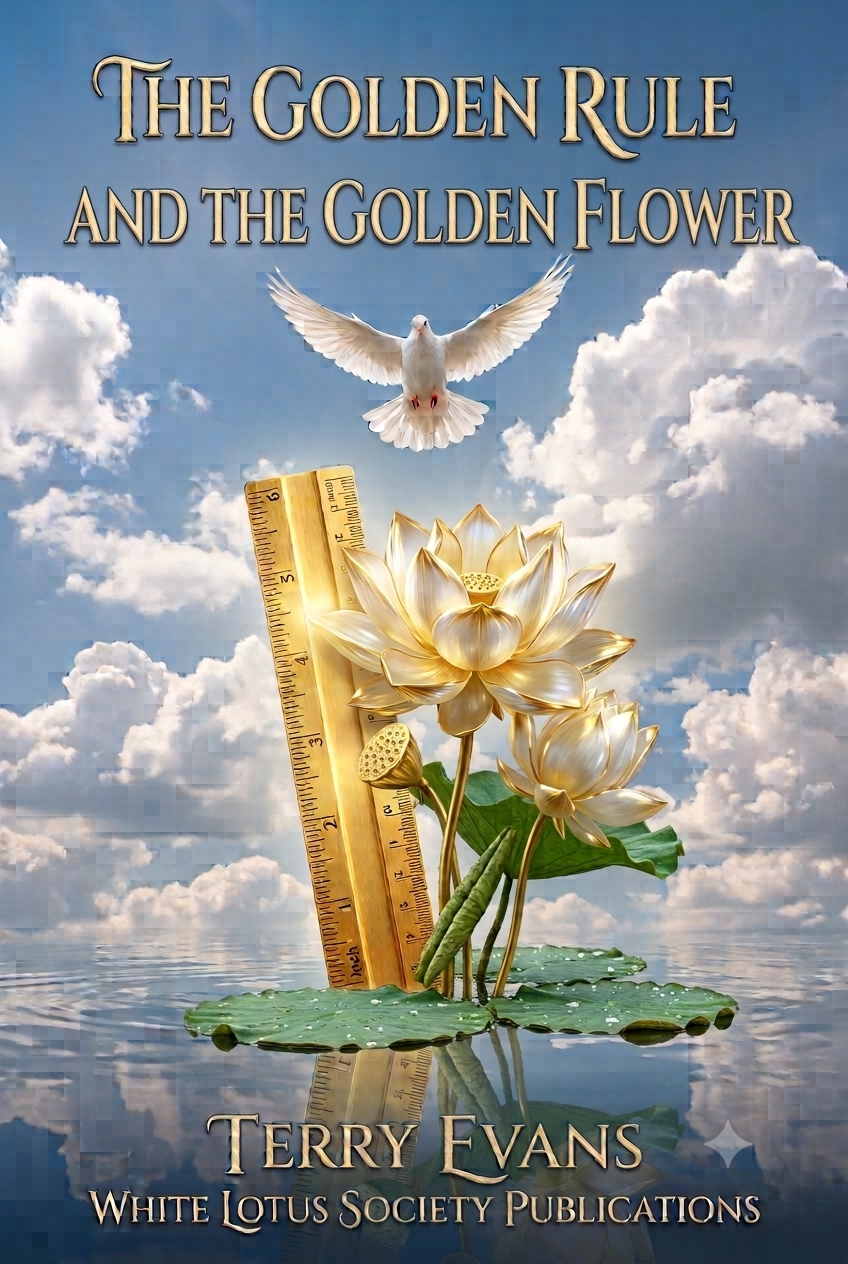
Golden Rule & Golden Flower
One Law in Every Tongue
One sentence that every people on earth has found without being told it, and has written down in its own alphabet, and has put at the head of its law. No missionary carried it. No council promulgated it. It rose in Egypt before Moses, in China before Confucius, in the forests of the Yoruba, on the Ganges, in Galilee, in the Persian hills, and in the mouths of grandmothers in every village that ever had a village. Do to others as you would have them do to you. That is our creed. This volume unfolds the Golden Rule across nine books — as foundation, symbol, pattern, path, and goal — and shows how it unites the wisdom of the Wise Men of Shambhala, the Pure Land tradition, Oriental Christianity, the Thomas Nazarenes, and the venerated ways of the Golden Flower shamans.
If your device downloads this as a .zip file, simply remove ".zip" from the file name and it will open in your ePub reader.
A Book of the Golden Flower Abbey
The Spirit & the Bride
The Divine Feminine and the Theology of the Marys
There is a sentence at the very end of the Christian scriptures that almost nobody preaches on: The Spirit and the Bride say, Come. Two feminine voices — the Breath that hovered over the waters before there was light, and the woman who stands at the end of the long road, dressed and waiting, who is also the assembly of every soul that ever loved God. This volume restores the feminine face of God — Ruach, Hokhmah, Shekinah, Sophia, and the Mother of Ten Thousand Names — and traces her through the Marys: the Mother who consented, the Magdalene who was sent, and the long tradition of the divine feminine from the Black Madonna to Guanyin to the Eternal Venerable Mother of the White Lotus.
If your device downloads this as a .zip file, simply remove ".zip" from the file name and it will open in your ePub reader.
A Book of the Golden Flower Abbey
The Lotus & the Lily
Four Lives, One Light
This is a book about four people who never met. Two of them were gentle: Mao Ziyuan taught farmers in the lake country of eastern China that they could say a Buddha's name and be saved; Francis of Assisi took off his father's clothes in a public square and taught the poor of Italy that the Gospel was still addressed to them. Two of them were fierce: Joan of Arc heard voices and lifted the siege of Orléans at seventeen; Wang Cong'er took up her husband's banner after the state killed him and led a hundred thousand people across four provinces before she was twenty-one. This volume narrows the thesis to its sharpest point: four faces, one light.
If your device downloads this as a .zip file, simply remove ".zip" from the file name and it will open in your ePub reader.
A Book of the Golden Flower Abbey
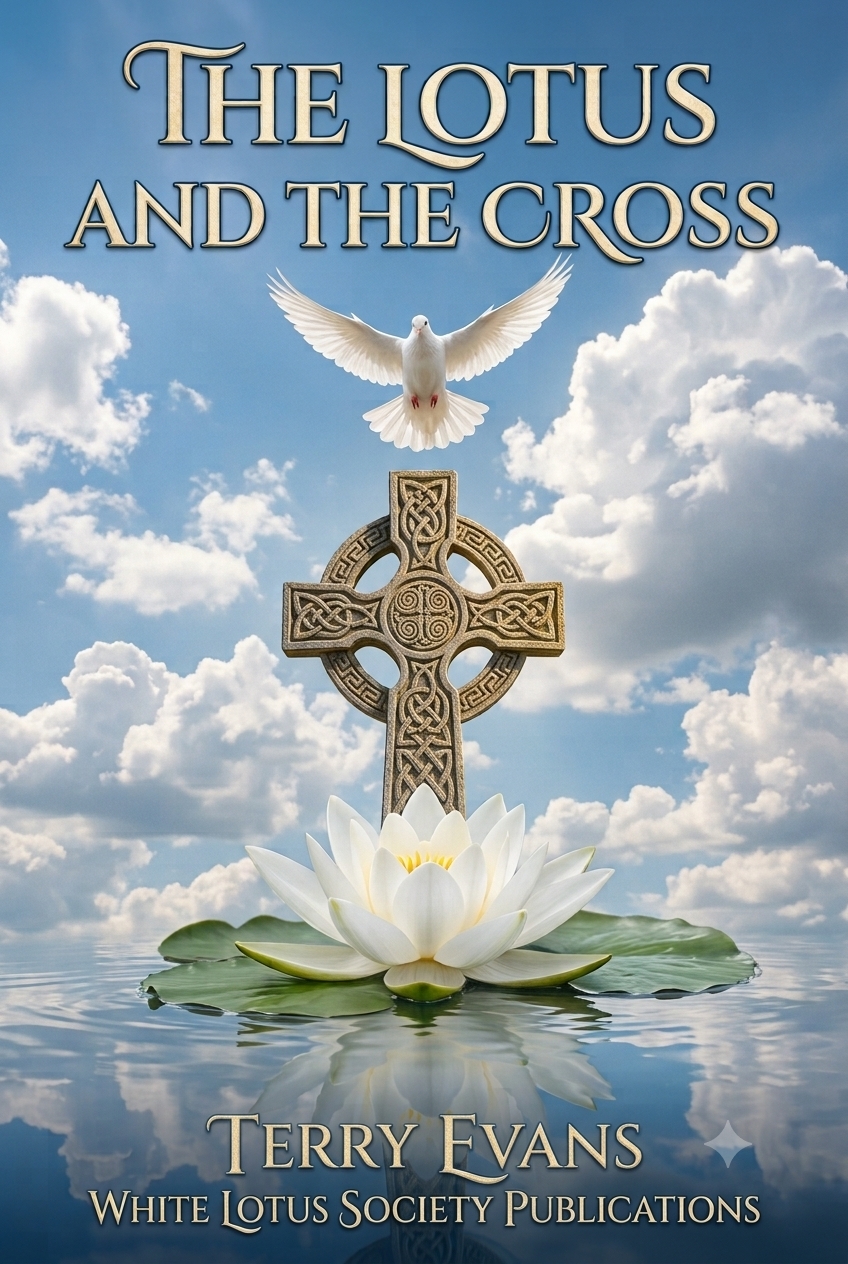
The Lotus & the Cross
Twin Paths of Faith and Power
There is an old habit in the writing of religious history that this book sets aside: the habit of telling each tradition alone, as though every faith grew in a sealed room. The Golden Flower Abbey stands inside a tradition that holds the Pure Land and the Luminous Gospel in the same two hands, and when we look back along our own descent — through Mao Ziyuan, through Huiyuan, through the assemblies at Mount Lu — we see the same story told in another language. This volume traces the parallel histories: the first fellowships, the monastic ark, the great reformers, the prophets who announced the turning of the age, and the long underground survival. Two civilizations, ten thousand miles apart, built the same church.
If your device downloads this as a .zip file, simply remove ".zip" from the file name and it will open in your ePub reader.
A Book of the Golden Flower Abbey
The Garden & the Altar
How Religion Followed the Flowers
Before there was a temple there was a grove. Before there was a doctrine there was a fragrance. This book is written from a simple observation that will not stop being true no matter how far back you follow it: religion follows the flowers. From Eden to the cloister garth, from the lotus ponds of Anuradhapura to the physic gardens of the monks, from the Rarian field at Eleusis to the enclosed garden of the Song of Songs, this volume traces the sanctuary garden through every civilization. The first altar was a garden. The first scripture was a fragrance. The first liturgy was tending.
If your device downloads this as a .zip file, simply remove ".zip" from the file name and it will open in your ePub reader.
A Book of the Golden Flower Abbey
Religion Follows the Flowers
The Litany of Sacred Names
Before there was a creed there was a colour. Before there was a commandment there was a fragrance drifting across a hillside in the hour before dawn, and someone stopped walking. This companion volume to The Garden and the Altar traces the single most overlooked fact in the history of religion — the flower was there first — and follows religion into the name: the litany of sacred names that a billion people carry without knowing where they came from. Ten books, seventy-two chapters, two hundred and sixteen articles of doctrine, and a litany that can be prayed in the garden.
If your device downloads this as a .zip file, simply remove ".zip" from the file name and it will open in your ePub reader.
A Book of the Golden Flower Abbey
The Flower Sutras
The Garland and the Lotus
There are two books at the far end of the Buddhist tradition that have never stopped astonishing people, and both are named after flowers: the Flower Garland, which describes the world as it appears to someone completely awake, and the Lotus, which makes a single promise in a dozen different registers — that no living being is spiritually second-class. The Garland asks what is the world? The Lotus asks who belongs to it? This volume walks through the teaching of these two great sutras in ordinary contemporary English, telling their own parables and unfolding their vision of a single connected universe in which no one is left outside.
If your device downloads this as a .zip file, simply remove ".zip" from the file name and it will open in your ePub reader.
A Book of the Golden Flower Abbey
The Tao of the White Lotus
Eighty-one verses of the Old Child, with three-voice commentary
A single lamp shows you the room. Three lamps show you the shape of the things in it. This volume was made in a house where three traditions are kept at once and none is asked to apologize. Here, each of the eighty-one verses of the Tao Te Ching is rendered in plain English for reading aloud, accompanied by three commentaries: the Taoist seed from which the verse grows, the echo that answers it from the Gospels and the Eastern Orthodox fathers, and the whisper that answers it from the Dharma. Each chapter closes with a single line of practice for the day. Three traditions, one lamp — and the light is the same.
If your device downloads this as a .zip file, simply remove ".zip" from the file name and it will open in your ePub reader.
A Book of the Golden Flower Abbey
White Lotus Harmony
The One River, Four Streams
This volume presents the whole life of Jesus Christ told once, straight through, as one continuous story. Matthew, Mark, Luke, and John are not four competing versions — they are four streams from one spring. Here the story runs as a river runs, weaving the four witnesses into the narrative in their own colours — royal blue for Matthew, emerald for Mark, burgundy for Luke, gold for John — so that at every turn you may see the narrative and the testimony together. The commentary is contemplative, not polemical, reading the Gospels through the understanding that God is the living Ground in whom all things exist.
If your device downloads this as a .zip file, simply remove ".zip" from the file name and it will open in your ePub reader.
A Book of the Golden Flower Abbey
Finding Shambhala
The Archetypal Garden of Panentheistic Religion
There is a village in Uttar Pradesh called Sambhal, with streets and shops and a temple. There is also a kingdom called Shambhala, ringed by walls of snow, laid out in the form of an eight-petalled lotus, and it has never appeared on any map at all. This book is about the distance between those two places — a distance not measured in miles. Finding Shambhala builds a philosophy of religion out of one image: the garden, arguing that the divine is not a ruler standing outside creation, but the living ground within which creation exists and beyond which it extends — panentheism.
If your device downloads this as a .zip file, simply remove ".zip" from the file name and it will open in your ePub reader.
A Volume of the Abbey Press
Creation Divine
The Blueprint of Creation
People have been arguing about the first page of the Bible for a very long time. Here is the strange thing: that whole argument is about a question Genesis never asked. Genesis is not a stopwatch — it is a blueprint. It tells you what had to come first, not how long it took. Light comes before living things. Sky comes before birds. Ocean comes before fish. From the Deep to the Breath, from day one to day seven, this is the story of creation — a companion volume to the full-length Genesis: Reimagining the Story of Creation, with shorter sentences, more examples, and nothing left out that matters.
If your device downloads this as a .zip file, simply remove ".zip" from the file name and it will open in your ePub reader.
The Whole Path in a Single Round Image
Celestial Dragon Pearl
Daoist Internal Alchemy and the Symbol of Return
The Celestial Dragon Pearl of Wisdom condenses the whole Daoist inner path into a single symbol. As the golden elixir, it is the luminous, purified fruit of internal alchemy. As the black pearl of creation, it is the dark, unmanifest source from which all things arise. As the essence of the soul, it is the original spirit cleansed of attachment and confusion, round, clear, and mirrorlike. Drawing on the Zhuangzi, the Daodejing, and the great Song and Qing dynasty alchemical masters, this study unfolds the pearl as a living symbol of spiritual attainment and the whole path of Daoist inner cultivation.
If your device downloads this as a .zip file, simply remove ".zip" from the file name and it will open in your ePub reader.
On the Eternal "I Am" Behind Every Name
Before Abraham Was, I Am
Panentheism, the I AM Sayings, and the Kingdom Within
When Jesus tells the Pharisees, "before Abraham was, I am," he is not making a claim about calendars — he is speaking the name given at the burning bush and locating it inside a human life. This book follows that single utterance outward through Scripture and the wider mystical traditions to a shared discovery: that the divine is not a distant sovereign outside creation, but the very being in which mystics of every age have found themselves grounded. Along the way it takes up the fundamentalist and the atheist as two faces of one dispute, both demanding a living mythology submit to the courtroom, and asks what remains once the trial is dropped.
If your device downloads this as a .zip file, simply remove ".zip" from the file name and it will open in your ePub reader.