Golden Flower Abbey
White Lotus Society
A Religion of the Heart, Over 1000 Years Old
The White Lotus Society is not a new synthesis. It is a genuine religion, its lineage unbroken for more than a thousand years, uniting Taoism, Christian Zen, and Pure Land Buddhism into a single living truth — rooted in the Divine Feminine of Shakti, Sophia, and the Queen Mother of the West, and carried by the ancient sacrament of entheogens.
One Path, Three Roots:
A Single, Ancient Religion
The White Lotus Society is not a modern invention wearing ancient borrowed robes. It is a genuine religion, its lineage unbroken for well over a thousand years — tracing to the White Lotus movement founded by Huiyuan on Mount Lushan in 386 CE, and carried forward on the same caravan roads where Taoist, Christian, and Buddhist monks met, translated one another's scripture, and recognized that they were drinking from the same well. This history is the Society's foundation, not its decoration.
The most common objection to holding Taoism, Christian Zen, and Pure Land Buddhism together as one religion rather than three is not hostility but bewilderment: how can three different traditions be a single path They have different founders, different scriptures, different cosmologies, different ritual forms, different languages for the ultimate. Are we not simply selecting the parts we like and calling the result a tradition Is this not a kind of spiritual tourism that honors none of its sources
These are serious questions and they deserve a serious answer. The Society's position is not that these three streams are identical, or that their differences do not matter, or that a person need not study any of them deeply. The position is more precise and more demanding than that: these three paths converge not despite their differences but through them, because each tradition, followed to its deepest stratum, arrives at the same ground — a ground that no single tradition fully names, but that each tradition genuinely touches. The differences are real. They exist at the level of form, practice, cultural context, and conceptual vocabulary. But beneath the forms, the water is the same water, and it has always been one religion wearing three faces, not three religions occasionally resembling one another.
This is not a new idea. The Perennial Philosophy — articulated by Aldous Huxley, by Frithjof Schuon, by Huston Smith, and before them by Meister Eckhart, by Ibn Arabi, by the Vedantic masters — holds that the world's great mystical traditions share a common metaphysical root. The Society does not simply repeat this argument. It embodies it, as a lived and ordained religious body with a continuous history, through three specific traditions that have a documented record of actual conversation, actual contact, and actual mutual recognition across the Silk Road and beyond — a record this page traces in full below.
 Monastery, mountain, and cathedral — one landscape, three vocabularies
Golden Flower Abbey —
A Legacy of Light
t Golden Flower Abbey, we start from a simple, universal truth: we are all children of the same universe. This is the ground we stand on, and it is the reason our gates are open to everyone, exactly as they are. Whether you arrive from a Christian, Buddhist, Taoist, or Agnostic background — or no background at all — you are welcome here. Every spiritual path has dignity, and our mission is not to evaluate your truth but to help you live it.
A Legacy of Light
We are the torchbearers of a forgotten light, tracing our origins to the school of Huiyuan, who founded the White Lotus movement on Mount Lushan in 386 CE. Today, the White Lotus Society serves as a modern Silk Road — a universalist, syncretic path where the best of Pure Land Buddhism, Christian Mysticism, and Zen flow together. Not blended into vagueness, but united at their shared root.

A Reconciliation of Buddhism and Christianity:
At the core of both traditions lies an ineffable ultimate reality. Buddhism names it Nirvana or Suchness — the unborn, unconditioned ground of being. Christian mysticism names it the Godhead — the silent divine essence beyond the personal God. This theology unites them in The Unmoving Light: a panentheistic source that contains all realms yet remains utterly transcendent.
The Bodhisattvas who populate the Pure Lands are mirrored by the Saints and Angels of Christian tradition. Amitabha Buddha parallels God the Father; Avalokitesvara/Guanyin parallels the Holy Spirit; Mahasthamaprapta parallels Jesus Christ. The feminine embodiment of mercy — Guanyin in the East and the Virgin Mary in the West — reveals a convergent archetype of divine compassion arising independently in both cultures.
Buddhism maps the wisdom that realizes the Unmoving Light; Christianity embodies the compassionate action that flows from it. Two waves on the same ocean. Two lenses focused on the same eternal mystery.

Botanical Wisdom
Our sanctuary is a living Materia Medica. We recognise the ancient relationship between plant medicine and spiritual wellbeing. We hold that sacred plants — including cannabis and psilocybin — are gifts from the Creator, vehicles for healing and encounter protected by the sacred relationship between the soul and the Divine, and by the First Amendment's guarantee of religious freedom.
Radical Equality
The Abbey is deliberately non-hierarchical. No gatekeepers, no institutional structures that place one person's voice above another's. Every member stands on the same ground. This commitment extends to our ministry: ordination is free, fully online, and open to all. The capacity for spiritual leadership belongs to the people, not the credentialed. If you feel called to serve, the path is clear and the door is open.
 The Yungang Buddha, the garden Madonna, the monk beneath the golden leaves
The White Lotus blooms once more in radiant peace. Welcome home.
The Divine Feminine:
Wisdom, Compassion, and Shakti
The White Lotus Society has never been a religion of the Father alone. From its earliest root, it has held that the ultimate ground of being is not only the nameless source but also the nurturing, birthing, wisdom-bearing womb from which all things arise — and every one of its three traditions names this directly, in its own oldest layer, long before the Society ever united them.
In the deep root of Indian and Vajrayana Buddhism, this is Shakti — the dynamic, creative energy without which realization does not move from concept into life. Wisdom (prajna) itself is figured as feminine in the Mahayana — Prajnaparamita, the Great Mother, "mother of all the Buddhas," from whom every awakened one is born. In Christianity, this is Sophia — Holy Wisdom, present at creation in the book of Proverbs, playing before God as the world is made — and it is the Holy Spirit herself, who in the Hebrew and Syriac of the earliest Church is grammatically and devotionally feminine (Ruach, Ruha d'Qudsha), brooding over the waters at the world's first dawn. In Taoism, this is the Queen Mother of the West (Xi Wangmu), keeper of the peaches of immortality and sovereign of the western paradise, one of the oldest deities in the Chinese pantheon and, in the earliest strata of Taoist religion, the primary object of popular devotion — the Tao's own maternal face, older even than the more familiar later iconography of Laozi.
Today, this sacred feminine has gathered, across all three roots at once, into a single beloved form: Quan Yin (Guanyin, Avalokiteshvara in her Chinese transformation), the Bodhisattva who hears the cries of the world and answers every one without exception. The White Lotus Society holds that Quan Yin, Sophia, Shakti, and the Queen Mother of the West are not four goddesses who happen to resemble one another. They are the same divine feminine, worshipped continuously across three traditions and three thousand years, wearing whatever face her devotees needed to see.
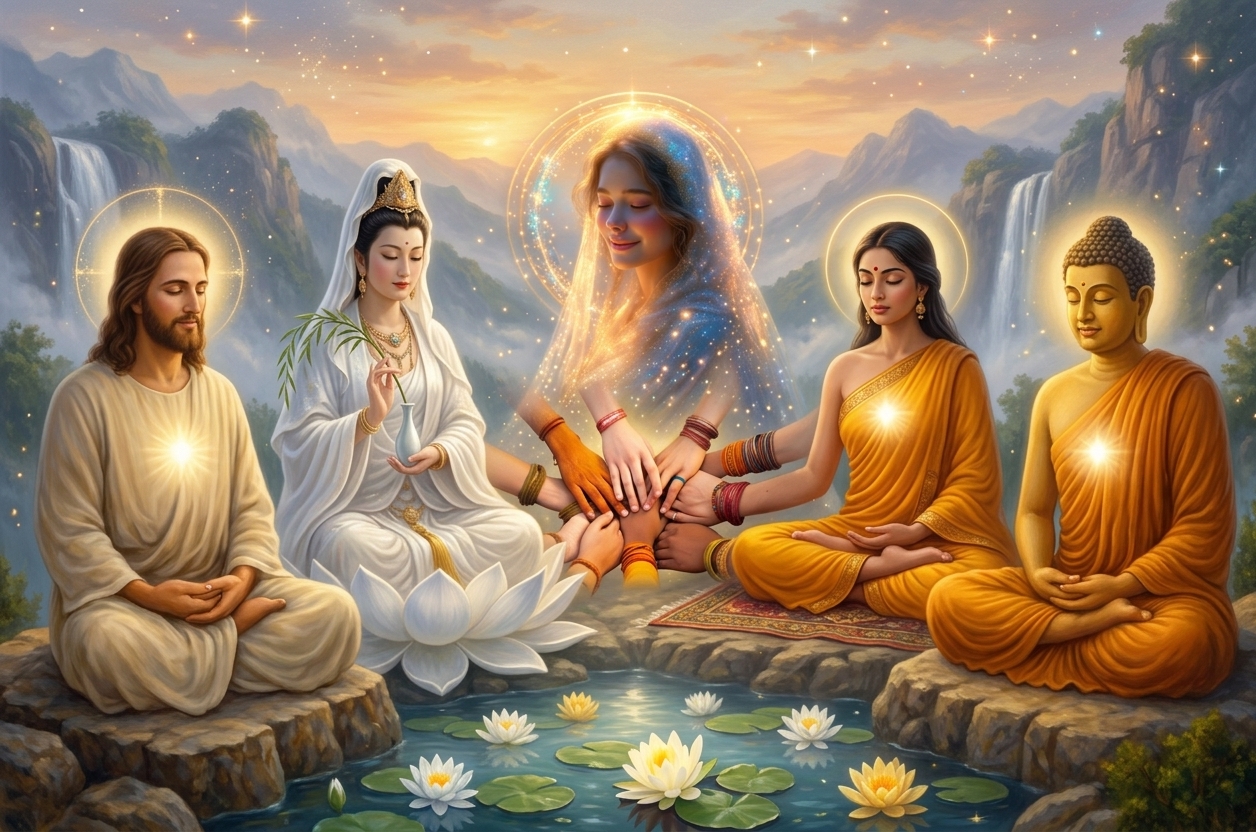 Shakti, Sophia, and Quan Yin — one Mother, hands joined across every tradition
The Queen Mother of the West, the Holy Wisdom who played before God at the making of the world, the Mother of Compassion who hears every cry — these are not different goddesses shining through different veils. They are one Mother, calling every tradition home to the same heart.
— White Lotus TraditionThe Tao: The Ground
That Cannot Be Named
Laozi opens the Tao Te Ching with the most important sentence in Chinese philosophy: "The Tao that can be named is not the eternal Tao." This is not a failure of language. It is a precise description of the nature of ultimate reality: it exceeds every concept including the concept of itself. The Tao is the ground of all being — the source from which the ten thousand things arise and to which they return, the principle of natural order that operates without forcing, the stillness that underlies all movement.
What Taoism offers at its deepest level is not a theology but an orientation — a way of relating to reality that moves with rather than against the grain of things. Wu wei, effortless action. Ziran, naturalness. Pu, the uncarved block — original mind before conditioning. These point toward what the Abbey identifies as the foundational recognition: that there is a prior, unconditioned awareness underlying all phenomena, and that aligning with it rather than fighting it is the essence of wisdom.
Taoism's contribution to the unified path is this: it refuses all metaphysical inflation. The Tao simply is — the isness beneath all beings, the silence beneath all sound. This pure apophatic thrust — the insistence that the ultimate exceeds every positive description — is precisely the corrective the path needs to prevent any element from hardening into idol-worship of a concept.


The Tao is like an empty vessel that yet may be drawn from without ever needing to be filled. It is bottomless — the progenitor of all things. It blunts the sharp, unties the knotted, softens the glare, settles the dust. Deep and still, it exists forever.
— Tao Te Ching, Chapter 4 (Laozi)Christian Zen: The Heart
That Knows by Unknowing
Christian Zen is not a compromise. It is the recognition that the contemplative heart of Christianity and the contemplative heart of Zen Buddhism are describing, in their very different languages, an identical interior territory: the dissolution of the ego-self in the presence of something infinitely larger, and the discovery that this dissolution is not loss but fulfillment.
The Christian mystical tradition — from the Desert Fathers, through Meister Eckhart, John of the Cross, The Cloud of Unknowing, Thomas Merton, and Centering Prayer — is built on a fundamental apophatic movement: stripping away every image, concept, and attachment to reach the Godhead beyond God. "God is a desert," wrote Eckhart. "Into this desert I go." The silence he describes is the same silence the Zen master points toward when he says mushin — no-mind.
 The silence beneath the gold — an Orthodox cathedral interior
Zen's great gift to the contemplative Christian is the insistence that the breakthrough to non-dual awareness — what Christian mysticism calls theosis, union with God — is not a doctrinal position but a direct, reproducible experience accessible through disciplined practice. Thomas Merton understood this. His 1968 Asian journals, written weeks before his death, describe Zen and Christian contemplation as two expressions of the same illumination.
The Society holds that the Christ is not diminished but enlarged by Zen: the historical person points to a universal principle — the way of self-emptying (kenosis), the way of love without ego, the way that the life of God flows through a human being who has released the barrier of self. This is the Christ-principle: not the property of any religion, but the universal pattern of awakened compassion that every tradition has recognized in its saints. And beside the Christ stands the Ruach, the feminine Holy Spirit of the earliest Church, brooding, hovering, bringing to birth — the same maternal wisdom the Society honors as Sophia.
When I go into the ground, into the depths, into the floor and fount of the Godhead, no one will ask me where I have been or where I am going. No one will miss me — for even God passes away.
— Meister Eckhart, Sermon 52Pure Land: The Grace
That Carries All Things
Pure Land Buddhism is the most widely practiced form of Buddhism in East Asia, and also the one most frequently misunderstood by Western students. On the surface, it appears to involve belief in a cosmic Buddha named Amitabha who created a paradise realm called Sukhavati, and a practice of calling upon his name — Namo Amituofo — to be reborn there after death. This sounds, to the Western ear, suspiciously like theistic prayer. It is meant to.
But the deeper teaching — articulated most profoundly by Shinran Shonin, and by the Huiyuan lineage that the White Lotus Society inherits — is a radical teaching about grace. Amitabha's original vow to save all beings without exception is not a claim about a supernatural entity. It is a description of what the Tao already is: the boundless, unconditional welcome at the heart of reality itself, the ground that accepts all things, the light that excludes nothing.
The nembutsu practice — the repetition of the Buddha's name — is thus not worship of an external deity but a method of surrender: the dropping of the grasping ego-self into the larger life it was always already part of. This is the same movement Zen calls kensho, the same movement Christian mysticism calls kenosis, the same movement Taoism calls wu wei. Three doors. One threshold. One room beyond.
Pure Land's irreplaceable contribution to the unified path is its emphasis on compassion for ordinary human beings — its insistence that the path is not reserved for monks and scholars. "Even the worst person," wrote Shinran, "is saved." Not despite their ordinariness but precisely through it — because the ground of grace does not require human perfection as a precondition. And it is Quan Yin, Amitabha's compassionate attendant, who carries that grace to each particular being who calls her name — the feminine face of the vow.
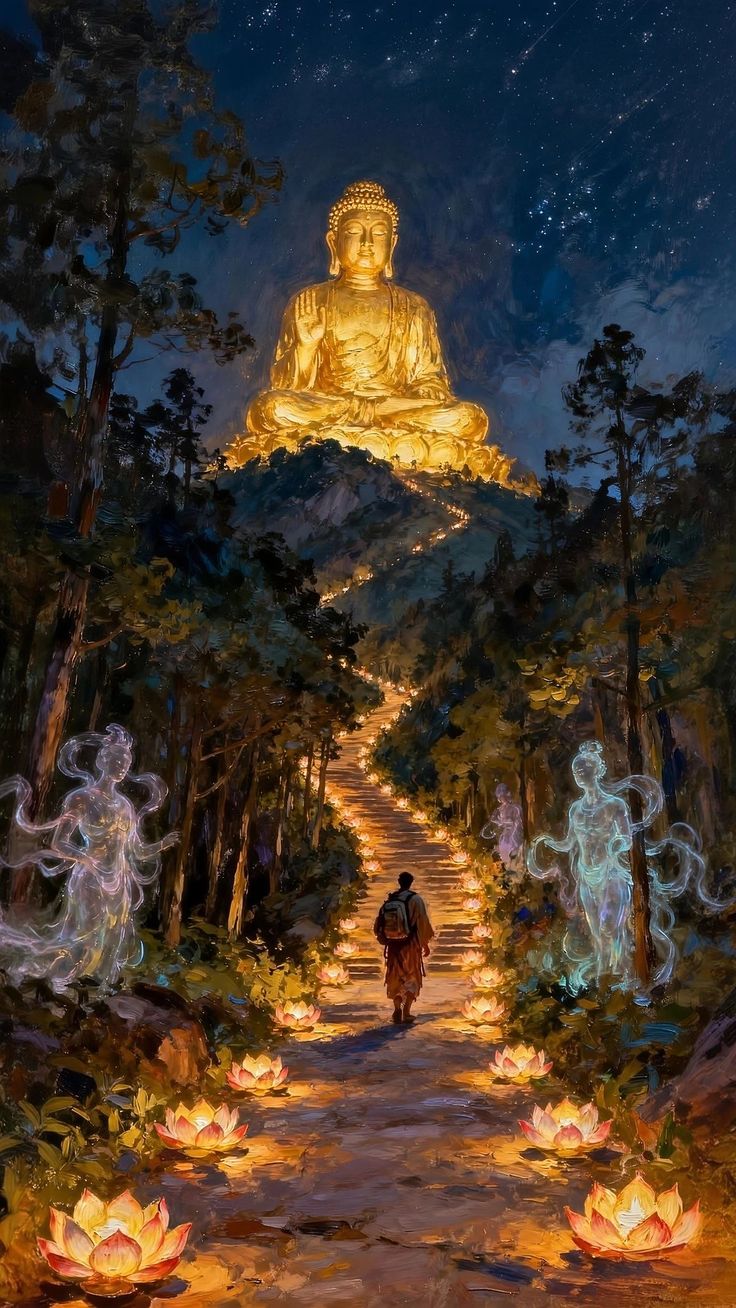 The lotus path to the Buddha of Infinite Light
If even the good person can be reborn in the Pure Land, how much more so the wicked person The person aware of their own foolishness, trusting wholly in Amida's Primal Vow — they are the very ones Amida had in mind.
— Shinran Shonin, TannishoAncient Roots:
Entheogens and the Mystical Path
A religion over a thousand years old does not begin with a philosophy. It begins with an experience — and across all three of the White Lotus Society's roots, the historical record shows that experience being occasioned, again and again, by sacred plants. This is not a modern addition grafted onto ancient traditions to justify a contemporary practice. It is the recovery of a lineage each tradition once knew openly and later, under pressure of institutional caution, allowed to recede into its own footnotes.
In Taoism: the entire discipline of external alchemy (waidan) grew up around the compounding of elixirs of immortality, recorded in exhaustive technical detail in the Taoist Canon — mineral and herbal preparations, some demonstrably psychoactive, ingested by adepts seeking direct visionary contact with the immortals and the Queen Mother of the West's own paradise. Internal alchemy (neidan) later reframed this pursuit as inner cultivation, but it never disowned its origin: the search for the elixir that opens the gate between the ordinary world and the Tao.
In Christian mysticism: the roots run to the Greek world Christianity was born into. The Eleusinian Mysteries, celebrated for nearly two thousand years at Eleusis near Athens and attended by Plato, Aristotle, and Cicero among countless others, centered on a sacred drink, the kykeon, that classicists and ethnobotanists have long argued produced a visionary state — the same Greek world in which the New Testament itself was written and first preached. The Essenes, contemporaries of the earliest Church, are likewise recorded using ritual preparations in their desert asceticism. The apophatic breakthroughs of the Desert Fathers, the Rhineland mystics, and the visionary tradition running through Hildegard of Bingen belong to the same family of directly occasioned mystical states that the Society honors as one continuous lineage of encounter, whatever specific means each generation used to reach it.
In Buddhism: the Vedic sacrament of Soma, pressed and drunk in ritual across the Rig Veda centuries before the Buddha's birth, seeded the visionary soil the Buddhist tantras grew from. The Vajrayana tantras of India and Tibet record the ritual use of potent plant and mineral compounds — amrita, the "deathless" nectar — to induce the direct, non-conceptual perception of reality that ordinary meditation approaches by a slower road. Soma, amrita, and the elixirs of the Taoist adept are not three unrelated customs. They are three regional names for the same discovery: that the ordinary boundary of the mind can be opened by a sacrament, not only worn away by decades of discipline.
The White Lotus Society holds this lineage openly, not apologetically. Sacred plants — including cannabis and psilocybin — are gifts from the Creator, vehicles for healing and direct encounter with the Unmoving Light, used with reverence, discernment, and ritual container rather than casually. The Society stands for the legal and spiritual freedom to use them in this way, protected by the same sacred relationship between soul and Divine, and by the same guarantee of religious liberty, that has protected sacrament in every tradition that has ever offered one.


Three Languages,
One Conversation
The following parallels are not analogies invented after the fact. They represent independently developed responses to the same human encounter with the same irreducible features of reality — features that appear in every tradition that has gone deep enough to find them.
 Three sanctuaries, one skyline
Beyond Tolerance:
The Nondual Recognition
Many interfaith projects rest on a foundation of mutual tolerance: we agree that other traditions have value and that we should respect each other's differences. This is admirable as far as it goes. But it does not go far enough. Tolerance still maintains the structure of separate traditions standing in respectful relationship to one another. It is ecumenism, not unity.
The Abbey's position is not ecumenical. It is nondual. A nondual recognition does not say "your tradition is valid and mine is valid." It says: the division between traditions, taken as an ultimate fact, is itself a form of the fundamental error that every tradition exists to correct — the error of taking the map for the territory, the finger for the moon, the name for the thing named. When Laozi says the Tao cannot be named, when Eckhart says God exceeds every concept of God, when Shinran says all beings are already embraced by Amida's light — they are each pointing past the boundary of their tradition toward the same boundless fact.
What the Abbey calls The Unmoving Light is an attempt to gesture at what lies beneath and within all three streams — the unconditioned awareness that Taoism points to as the Tao's own nature, that Christian contemplation touches in apophatic prayer, that Pure Land Buddhism names as the Dharmakaya — the truth-body of all Buddhas — from which Amitabha's compassion endlessly radiates. One reality, three ways of turning toward it. One light, three windows.
 One light, three windows — the cathedral arch opening onto the sacred mountain
Panentheism: The God
In Whom We Move
There is an old philosophical error that panentheism corrects. Classical theism places God wholly outside the world, a watchmaker at a distance from the watch. Pantheism collapses the distinction the other way, declaring God and world simply identical. Panentheism refuses both simplifications: the world is in God, as a wave is in the ocean, and yet God exceeds the world the way the ocean exceeds any single wave. God is the ground the world floats in, and also more than the world could ever exhaust. Every one of the Abbey's three roots arrived at this same structure independently, and every one of them names the transcendent term the same way — as a kind of open, luminous unknowing.
In Taoism this is simply the Tao itself: nameless, prior to Heaven and Earth, the mother of the ten thousand things, and yet fully present in each blade of grass, each breath, each turning season. The Tao that can be named is not the eternal Tao — and yet the eternal Tao is what moves the water downhill and the seasons through their wheel. It is both the vessel and what fills it.
In Buddhism the same structure appears as the relationship between Nirvana and Samsara, or between the Dharmakaya — the truth-body of all Buddhas, the unconditioned ground — and the world of appearances it gives rise to without ever being reducible to them. The Heart Sutra's great equation, form is emptiness, emptiness is form, is panentheism in eight syllables: the conditioned world is not other than the unconditioned ground, and the unconditioned ground is not other than the conditioned world, and still the ground is called unconditioned because it is never exhausted by any form it takes.
And in Christianity, this is the God Paul names on the Areopagus in Athens — not a new god competing with the old ones, but the one the Athenians had already built an altar to and simply left unnamed. Standing before that altar, Paul does not correct their intuition; he completes it.
The God who made the world and everything in it … is not far from each one of us, for in him we live and move and have our being.
— Acts 17:24, 27–28, Paul at the Areopagus"In him we live and move and have our being" is not deist or classical-theist language. It is panentheistic language — the same architecture as the Tao that carries the ten thousand things, the same architecture as the Dharmakaya that gives rise to every appearance without being confined to any of them. The Unknown God of the Areopagus, the nameless Tao of the opening line of the Tao Te Ching, and the Nirvana that Mahayana teaching refuses to separate from the world of suffering beings — these are not three different claims about ultimate reality arrived at by chance. They are three sightings of the same horizon from three different mountains.
 Three columns, one summit — the axis where the transcendent meets the immanent
A Jungian
Reading
Carl Jung, who wrote the psychological commentary to The Secret of the Golden Flower and spent decades in direct conversation with Chinese alchemical and Zen sources, proposed that the human psyche is not a closed, private container but the surface expression of a shared, transpersonal substratum — the collective unconscious — populated by recurring patterns he called archetypes. Chief among these is the Self: not the ego, not the personality, but the archetype of wholeness and totality toward which the entire psyche is oriented, and which Jung identified with the imago Dei, the image of God imprinted in the depths of every human mind.
Read through this lens, the transcendent-immanent God of panentheism and the Jungian Self describe the same discovery from two directions. Mystical traditions approach it from the outside in, as a reality larger than the cosmos that nonetheless indwells it; depth psychology approaches it from the inside out, as a center of the psyche larger than the ego that nonetheless indwells it. Individuation — Jung's term for the lifelong process of integrating the unconscious and becoming a whole self — is structurally identical to what Taoism calls returning to the uncarved block, what Buddhism calls awakening to one's original Buddha-nature, and what Christian contemplation calls the recovery of the image of God buried beneath the false self. In each case, the goal is not the acquisition of something new but the uncovering of a wholeness that was there from the beginning, concealed by conditioning, fear, and the small, defended ego that mistakes itself for the whole of who one is.
Jung's insight was that this archetype of the Self reliably appears in dreams, art, and myth across cultures wearing the same handful of masks: the mandala, the sacred marriage, the wise old figure, the luminous child, the circle with a center. It is no accident that the Abbey's own symbol of the Unmoving Light, the Buddhist mandala, the Taoist circle of yin and yang, and the rose windows of the Christian cathedral are all the same geometric intuition rendered in three different vocabularies: a center that holds, surrounded by a boundary that includes. The archetype does not belong to any one tradition. It belongs to the structure of the human psyche itself, which is why every tradition that has looked deeply enough has found it there, waiting.
The Silk Road:
Where the Roads Actually Crossed
This convergence is not merely a philosophical resemblance discovered from a comfortable distance. The three roots met, physically, repeatedly, on the caravan roads and in the oasis cities that connected the Mediterranean world to China for well over a thousand years — and the meeting left a written, carved, and painted record that still survives.
When the Church of the East reached the Tang capital of Chang'an in 635 CE, its missionary monks did not build a fortress of untranslatable doctrine. They reached for the vocabulary already at hand — the vocabulary of Taoist and Buddhist scripture — and rendered their theology in it. The great Nestorian Stele, carved in 781 CE and rediscovered in Xi'an in the seventeenth century, translates the Christian Logos using the Chinese character Tao — the very word Laozi used for the nameless ground of all being. The Christian monks who wrote it were fluent enough in Taoist and Buddhist thought to reach for wu-wei, non-action, as a description of divine grace. This was not mistranslation. It was recognition.
Along the same roads, the oasis towns of Dunhuang, Turfan, and Kashgar functioned as genuine centers of religious cohabitation, not segregation. The Mogao Caves at Dunhuang, one of the great libraries of the ancient world, preserved Nestorian Christian texts in the same complex that housed thousands of Buddhist sutras — copied, it appears, by scribes and translators who moved between traditions as a matter of professional and spiritual course. Manichaeism, born on these same roads, openly fused Zoroastrian cosmology, Christian redemption, and Buddhist metaphysics into a single missionary faith that spread from Persia to China. And centuries earlier, in the Buddhist kingdom of Gandhara — itself a Silk Road crossroads seeded by the successors of Alexander the Great — Greek sculptors gave the Buddha his first human face, a face borrowed unmistakably from Apollo. The most recognizable image of the Buddha in the world today is, in its origin, a Hellenistic god's face wearing a monk's robe.
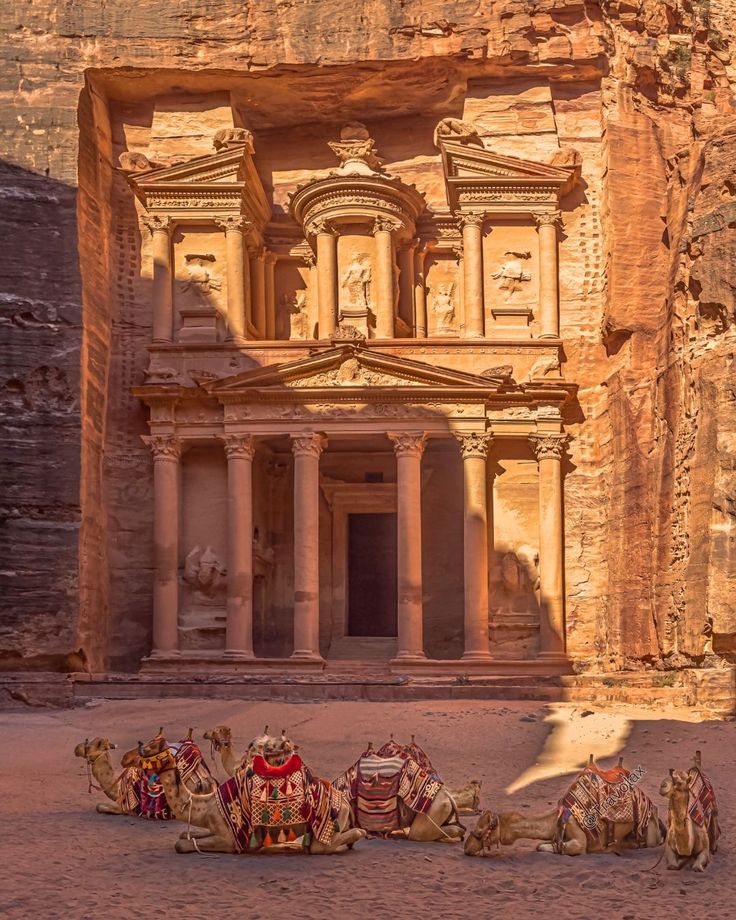

None of this was accidental proximity that left the traditions untouched. Translators, monks, and merchants who lived and worked in these cities were often fluent across two or three of these vocabularies at once, and they used that fluency exactly as the Abbey uses it now: to say the same thing three ways, because it seemed to them — as it seems to the Abbey — that it was the same thing. The historical record does not show three sealed traditions that happened to occupy the same trade route. It shows monks translating each other's scripture, artists borrowing each other's sacred faces, and theologians reaching for each other's words because those words were the closest available fit for what they were each trying to describe: the one hidden God, moving under three names, on roads that had already brought their peoples face to face.
 Roads that had already brought their peoples face to face
The Ocean and the Waves:
Neither Impersonal Nor Merely Personal
It is a common misunderstanding that panentheism — the recognition that all things are in God and God is in all things — erases the personal nature of the Divine, leaving behind only an abstract ground that cannot be prayed to, loved, or met face to face. The White Lotus Society rejects this false choice with its full theological weight. The Unmoving Light is indeed the impersonal ground of all being — the Tao that cannot be named, the Dharmakaya beyond form, the Godhead silent beneath God. Yet this ground is not a sterile void. It is the living, relational source from which every instance of personal encounter with the Divine flows, and it has never asked the Society's practitioners to give up their saints, their angels, or their bodhisattvas in exchange for a purer abstraction.
Just as the ocean expresses itself in waves, tides, and currents without ceasing to be one ocean, the Unmoving Light expresses itself in a cascade of personal beings — avatars, angels, saints, and spirit guides. These are not separate from the ground; they are the ground made particular, made near, made willing to be addressed by name. They are the visible rays of an invisible sun, and the sun is no less itself for shining in many directions at once.
 The cascade gathered: sage, saint, bodhisattva, avatar, and guide, one valley between them
Avatars and Incarnations are the direct descent of the ground into a single human life, offered so that the abstract might become an example that can be followed. The Society recognizes Christ as the Logos made flesh, the Buddha as the fully Awakened One, and the Taoist Sage as the perfect, unforced embodiment of Te — three descents, not three competitors, each a complete door to the same summit.
Angels, Devas, and Celestial Beings are the ground's own ministers, the intermediate order that carries the light from the infinite into the finite. Taoism's celestial bureaucracy governs the unseen flow of cosmic energies; Christianity's nine choirs of angels sing without ceasing before the throne; Buddhism's devas and Dharmapalas guard the teaching and the practitioner alike. Different names for the same order of being: closer to the source than we are, and sent to help us close the distance.
Saints and Patriarchs are perfected human beings who have realized the Unmoving Light within a single lifetime and continue, the Society holds, to assist from the other shore. Huiyuan, Shinran, Meister Eckhart, the unnamed Desert Mothers and Fathers, and every quiet mystic history did not think to record — these stand in one communion, proof that the summit is reachable and companions on the way up it.
Spirit Guides and Protectors are the most intimate rank of the cascade — the personal bodhisattva, the guardian angel, the particular presence that meets a single soul in its own particular suffering. They are the ground of being narrowed, by love, to the size of one life at a time.
And presiding over the entire cascade, nearer to it than any other figure the Society honors, is the Divine Feminine herself — Quan Yin, Sophia, the Queen Mother — who is at once the impersonal Shakti that animates the whole cascade into motion and the most intensely personal face any devotee has ever wept in front of. She is proof, standing at the center of the doctrine, that the ground and the face were never two things.
 The pilgrim's road and the saint's vigil, sharing one hillside
The absolute is the ground of the personal, and the personal is the face of the absolute. The Unmoving Light does not abolish the angels; it gives birth to them. We bow to the nameless Tao and pray to Quan Yin by name without contradiction. Both are true. Both are necessary. Both are lived.
— White Lotus TeachingNot Syncretism,
Not Compromise
A common anxiety about the Abbey's approach is that it represents syncretism — the mixing of traditions into a blended product that is authentically none of them. The anxiety is understandable. Syncretism is a real spiritual danger: the production of a vague, comfortable spirituality that avoids the demanding edges of any real path. The Abbey explicitly rejects this model.
What the Abbey proposes is not a blend but a recognition of a shared depth. A practitioner of the Abbey's path does not study a little Taoism, a little Zen, and a little Pure Land Buddhism and call the resulting mild familiarity a spiritual life. The Abbey encourages each practitioner to go deep into whichever of the three streams speaks most directly to their nature — and to understand the other two as different expressions of the same living reality, not as competitors to be sampled.
The image is not a blender. It is a tree. A tree with three great roots drawing from the same underground water. The roots are different — different structures, different textures, different relationships to the soil. But the water they draw from is the same. The tree is not a blend of three root-varieties — it is something that could not exist without all three, yet exceeds all three in its living wholeness.
 Depth, not blending — a single tradition's altar, undiluted
Seven Principles of
the Unified Path
These are the foundational recognitions of the Abbey's teaching — not articles of belief to be assented to but orientations to be explored, tested against experience, and gradually confirmed or refined through the practice of a lifetime.
 Orientations tested against experience, not articles assented to
Three voices. One song.
One light. No walls.
The White Lotus blooms in every tradition that has the courage to follow its own depths all the way to the ground — where it finds, waiting there, the roots of every other flower. The Mother shines through every name we have given her. The sacred plants are gifts, not transgressions. The saints and angels are near, and the ground beneath them holds without end. All are welcome. All are held.